Showing posts with label Prayer. Show all posts

Tuesday, April 15, 2014

Make Room

Today, Tuesday of Holy Week, while surfing around on Facebook, this irreverent and flippant (and funny) meme popped up:


And, well... it got me to thinkin'. Scripture is neat that way: often even a sidelong and casual glance at it will burns a reflection into the mind. Is not my word like fire? (Jer. 23:29).

You see, it is Holy Week, and someone thought this was an appropriate post for the occasion. And that is because, in all of the synoptic accounts of the events of Christ's final entry into Jerusalem and His passion and death, this event - the "Cleansing of the Temple" - is placed in the very days leading up to the climax of the story.

But what is interesting is that, in John, the incident is placed quite early - in chapter two, in fact.

So, what gives?

Well, of course, details in the narratives, and particularly timing - and especially in John, who includes weighted little descriptors like "and it was night" - can be theologically significant. Anyhow, though, we won't digress into debates of the synoptic problem and all that. After all, it is as likely as not - in the present case - that the placement of the synoptic accounts of this particular event corresponds to the historical fact: indeed, the ruckus caused in this scene not only provide motive for those who would petition Christ's death, but also a rationale for the Roman government to quell a known rabble-rouser.

What's interesting to me, though, is that this scene comes in the narrative of this week - and what it might mean for each of us.

Of course, it's always worthwhile in these matters to consult The Fathers.

Jerome reminds us why this exchange trade was going on in the Temple in the first place [emphasis added]:
It should be known that in obedience to the Law, in the Temple of the Lord venerated throughout the whole world, and resorted to by Jews out of every quarter, innumerable victims were sacrificed, especially on festival days, bulls, rams, goats; the poor offering young pigeons and turtle-doves, that they might not omit all sacrifice. But it would happen that those who came from a distance would have no victim.
 The Priests therefore contrived a plan for making a gain out of the people, selling to such as had no victim the animals which they had need of for sacrifice, and themselves receiving them back again as soon as sold. But this fraudulent practice was often defeated by the poverty of the visitors, who lacking means had neither victims, nor whence to purchase them. They therefore appointed bankers who might lend to them under a bond.
Now, Jerome's interpretation of this passage, as with most Patristic commentators, seems basically to be that it contains a moral for priests and bishops and others who minister in God's sanctuary.

But, if I may, I find something fascinating in the background Saint Jerome chooses to give here - how potentially packed with meaning it is! Think about it: people too poor to provide a victim to satisfy... and laid upon them, by those supposed to help them gain atonement, a kind of double-debt on top of the first debt of the Law.

This is all of us: for humanity, on its own, is so impoverished, and also so doubly-in-debt: we need both a true Victim and a true Priesthood. And in the events of the same week in the Gospel, Christ presents Himself as both, and initiates in the same Last Supper the two sacraments that shall re-present Him as Victim and Priest to all the baptized until the end of time: the Eucharist and Holy Orders.

On top of this, Origen saw in this passage even more meaning still, applying it equally to us all and not just to our ministers:
Mystically; The Temple of God is the Church of Christ, wherein are many, who live not, as they ought, spiritually, but after the flesh; and that house of prayer which is built of living stones they make by their actions to be a den of thieves.
Yes, other reflections on this wonderful scene have been offered, and will continue to be. Of course, it has also to do with issues of avarice and greed, and the relative blessedness of the poor - after all, immediately after we see iniquity chased from the Temple, we see the lame and the crippled invited in to be healed. But I offer that we shouldn't press any social justice reading of this too far: after all, of all the Gospel accounts, the tersest and in some ways least interested comes from Luke, who is usually identified as the Evangelist most concerned with the plight of the poor.

Instead, I offer that the central motif here is one of MAKING ROOM: making a space ready for a new thing to be ushered in. Therefore, it is somewhat incidental to us whether this historical event happened in that first historical Holy Week or earlier in Christ's ministry - (or, as Augustine and others suggest, it happened twice). For us, in any case, there is a great spiritual merit to making it part of our Holy Week now.

We are the Temple of God. Indeed, beyond what Origen here observes, we should also be reminded that each of us is  "A Temple of the Holy Ghost". (I might also commend to your reading this week, along with this passage, Flannery O'Connor's brilliant story by that title.)

In order to "make room," as it were, for His Victimhood, His Priesthood, and His Rites of Atonement, Christ first had to clear out what only foreshadowed these, and imperfectly. Furthermore, He made it clear clear that the New Covenant demanded a break from all worldly thought: no hedging bets and conniving would have any place. Christ's rebuke to Peter - "You are thinking as man does, but not as God" - comes back to us here this same aspect of meaning as Christ's demonstration in the Temple. This was a merciful act, and an act of love: these things had to be cleared out, for they were passing away: the animal sacrifices and the dealings and the calculations were all to fade away under the shadow of The Cross. That Cross was the one and only payment that could be made, and we must bind ourselves over to it and to no other debt.

Holy Week provides us a last and urgent opportunity to "make room," even if all of our Lent has been squandered. It gives us a chance to clear out the old ways from our life, to abandon our compromises and our bets, and to cancel all our debts to falsehood.

We are the Temple of God. And we might find ourselves sometimes very much a den of thieves. But the True Victim and the True Priest, He Whose Temple it is... well, this is what He does. He rebuilds and restores the Temple. He cleansed the Temple once (or twice) upon a time. He restored the Temple (of His body) after three days following its destruction. And He rebuilds us, however broken from sin we may be, each and every time we fall - indeed, each and every day, with His Grace. We just need to make room for Him to do what He does.

Tuesday, January 7, 2014

Quick Invitation and Call to Prayer

If you're at all like me, you may have groused, groaned, mumbled, grumbled, or even uttered an oath upon stepping out of doors into the extreme cold these past couple days.

I don't guilt myself with that, nor do I think you should, but I do see an opportunity in it for growth in virtue and for efficacious prayerful offering. And so that's what I'm going to do, and I decided I'd invited you to do the same.

As Wednesdays are a traditional day of fasting and penance anyhow, and as it will still fall at least somewhat in the cold snap for most of us here in America, I'm inviting my friends and readers to make tomorrow, Wednesday, January 8, a day of fasting and prayer for the less fortunate.
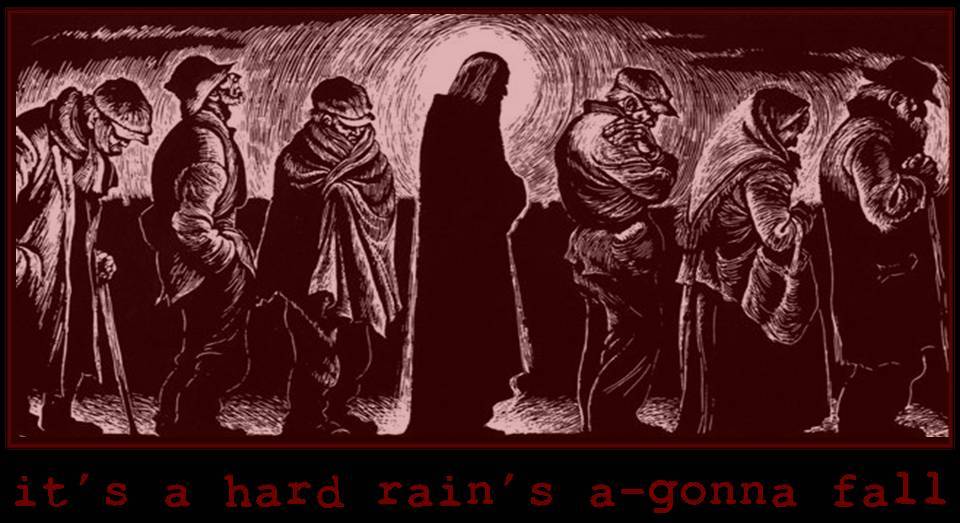
"Christ of the Homeless" (1982) by Fritz Eichenberg
In addition to the ordinary means of fasting by abstinence from meat and reduction in victuals, I'd also recommend trying to make a spiritual offering of the suffering involved in encountering such cold weather - and yes, it is a kind of suffering, and maybe for some of us (depending on various conditions we might have and the like) a greater suffering than for others.

But of course we can also take the opportunity to pray through this experience as well, reminded as we are by this suffering of the cold that there are many more less fortunate who suffer much more terribly, without shelter and proper clothing, dependent upon the charity of others. (And, needless to say, while I won't go so far as to challenge us to go looking tomorrow for an opportunity for charity, I hope we will hold ourselves ready to act upon such an opportunity should it arise.) All of which is to say, there should be no lack of substance for meditation and reflection as we imagine what it must be to lack shelter on days such as this: Hospes eram, et collexistis me (Mt. 25:35).

So, I hope you'll join me in making a special offering of suffering this cold weather tomorrow (Wednesday, January 8th), adding to it prayer and fasting, offering any part of our discomfort through it all up in prayer to God, calling for His generous blessings upon the less fortunate and acting in reparation for whatever sins of mankind might be contributory to making them so unfortunate.

+ A.M.D.G.

Wednesday, December 11, 2013

Practice in Full Gear

I dream of a "missionary option," that is, a missionary impulse capable of transforming everything, so that the Church’s customs, ways of doing things, times and schedules, language and structures can be suitably channeled for the evangelization of today's world rather than for her self-preservation
 - Pope Francis, Evangelii Gaudium 27
Try as I may to put a limit on my own admitted tendency toward reading too much of the momentous into something that may be purely mundane, I just cannot break the habit. It's been with me a long time, a kind of quixotic playing-at-prophecy, which I really do think a fundamental kind of silliness about my worldview. On the one hand, I'll admit, it does have a certain charm and helps me to sustain the Chestertonian habit of wonder at the world and seeing old things new. And perhaps sometimes it genuinely is a conduit of graced insight, an exercise of the gift of prophecy contained in my sharing in Baptism through Christ Jesus. But I fear that most often it's a bit of tilting at windmills, a spur that is a useful and quick expedient to avoid acedia but not a true virtue rooting out the underlying problems. But then sometimes I figure - so be it. If I play the fool, I might as well play boldly and thoroughly.

The thing is, I've been sitting with Pope Francis's new exhortation Evangelii Gaudium since it first hit the internet, and the whole time I've only been able to feel like this is a really important moment for the Church.

Then I started, as I am wont to do when I think I've felt that vibration, that twitch on the thread, to try to trace and to follow that thread, to pick it up in what's come before. This is where I usually play the fool like I said. This is where I'll try to explicate the phenomenon, to try to explain why this is so momentous, where the ripples can be seen in, say, the former papacy or in the culture or - whatever. The habit, which serves well for maybe certain kinds of research or scholarship, is probably annoying from someone trying to comment on culture, though: and that's all that this blog is supposed to be about doing. And it is fighting this temptation, often enough anyway, that ends up keeping me away from bothering to blog at all.

So I'm not going to do that this time. Because something else has occurred to me recently, in study and prayer over this document: that there's something akin in this tendency of mine to a sports team that never practices in full gear before suiting up for the real game. Of course I need to theorize about culture - about how to restore Catholic culture and Western culture generally, about how to recover so much that's been lost, about the challenges that our milieu offers that may be unique and unforeseen, about which philosophies (like Distributism and Personalism) are best suited to meet those challenges - but the problem is that mere theorizing never gets me into gear and begins to test, to experiment, with those hypotheses. Tracing the thread of why this "moment" is here is one way of working out my vocation in the world, sure. But then, maybe there's another way: another kind of practice. Practicing in full gear. Getting in some hits. Maybe taking a few. And then reviewing the film. (Okay, you get the metaphor, sorry.)


So, here it is: I'm issuing a challenge, for myself and for anyone who wants to undertake it along with me, to take Pope Francis's words to heart in a really practical way.

The idea for this experiment arose for me when considering the season. At this time of year you will hear maybe more often than at other times of year snide remarks about "the Christmas and Easter Catholics." You know who I mean: those people who only come to Church on the major holidays.

"They should be ashamed of themselves," the Church Mice say. And I won't deny it at all: the Church Mice are right. They should. All sinners should, for their sins. But year after year the disputes arise over practical and pastoral approach in this regard: sure, they should feel ashamed of themselves, but is it any good for them to feel like we think they should be ashamed of themselves? Will that be liable to make them, in fact, ashamed of themselves, or just to think we're jerks and give them another reason to not want to come to Church the rest of the year? But if they do feel that way, is that our problem? ... and on and on. [And I hope that the presentation of the debate here registers my ambivalence and isn't mistaken as favoring one side over the other(s) - because I really don't know.]

It's a tough question, to be sure. But I don't want to raise that debate here, much less settle it. I don't want to address it at all. That's just running drills. I want to put on some gear and call a play. [And as a note aside here, I can't claim this idea as my own: it was actually urged by the Bishop of my own Diocese, the Diocese of Allentown, as a practice for Catholics of the Diocese to mark the Year of Faith. I'll admit that I didn't take his advice, and that's a shame. But now I want to try out what he proposed, but with a spin in the spirit Pope Francis has commended in his exhortation (and by his example).]


So here's the play:

We all know somebody who doesn't attend Mass despite the obligation to do so. Or at worst, if we don't know somebody in that predicament, maybe we know (or in the absence of totally knowing at the very least have a pretty shrewd idea about) somebody who hasn't been to the sacrament of Reconciliation in a pretty good while.

We tend not to make these things our business. But I think Pope Francis is challenging us to be missionaries in precisely this way (and so many more). And this is the easiest thing I can think of that puts the spirit he's advocating to the test: let's make it our business. Pray about, discern how, and then approach one person who needs to be 'evangelized' this way and do the work: make the suggestion, have the conversation.

But beware: don't just rush out to the first person you think of. Think of anyone you can, first; but then (a) pray for all of them but (b) try really hard to narrow it down and to figure out who the easiest 'target' is. Too often in spiritual endeavors we set ourselves up for failure, especially early on. We should make a practice when trying to grow in virtue of picking achievable goals. So don't pick the person most likely to fly off the handle. Don't pick the person for whom it will likely leave a weird mark on your relationship for the rest of time and render things never the same again. No. Pick the person who in the worst case scenario says, "Nah, bro, I'm just not really feeling that right now," such that - in that event - you'll be okay (at least for the time being) letting it drop there and you'll both be "cool" with the outcome.

See, it's the last bit of the plan there - about picking the easy target and what identifies that - that I couldn't really work through to last time I thought about doing this (when the Bishop of Allentown recommended it). But it is a key component because it isn't the last step.

Because the last step... well, second to last, really... is praying again. Regardless of the outcome: praise God, thank Him, and give Him glory. I'm not going to tell you how to pray, of course - that's a sub-plan that I'm keeping private in my own case as well. The point is, though, we need to return from this encounter to prayer, realizing that if it was a positive outcome it was God's work and that if it was a negative outcome it's still in God's hands anyway and we need to chill out. [And, although I did say I wouldn't tell you how to pray, I will make so bold as to add this as a, shall we say, 'practical necessity': don't forget Mary, especially if it has been a positive trial. She is the help of Christians, present at any conversion, and deserves recognition because if not Baby Jesus cries, the end.]


So, I said that wasn't really the last step, and here's why:

Because we need to share our experience and discuss our trials. This, in a sense, is really the most important part of the test. Well, that is to say, from my vantage point, considering it as a test. Obviously, yes, the conversion/recovery of a Christian soul and prayer and, well, all of that is of greater importance.

But I want this to be a proof of concept and that requires us to communicate and, well, 'commune.' I am firmly convinced that in a way we have been issued 'marching orders' by our Holy Father - but it's up to us to figure out how to deploy and some other tactical nuances. This is my proposed way of doing that.

Who's with me?