Showing posts with label Human-Scale Thought. Show all posts

Wednesday, November 26, 2014

Ferguson and the Media

Here's my final thought on Ferguson for the time being. (The rest are on Facebook, incidentally, if you're accessing this through the blog and wondering,  "Last of what series?")

I've watched/listened to probably something like six hours of coverage in the last 36 hours.  One of the developing tropes, coming out of yesterday's press conference, is the role of the news media in all of this. I want to say something about that.

Let me admit up front that I have a natural affinity for, and probably even bias in favor of, journalism and journalists. This might, however, shock some readers who see me often decrying "the media" and especially "the mainstream media" as complicit in terrible things. But that's because I make a distinction when I speak of "the media" - and there's the rub. It wants elucidation.

I have in mind here especially the 24 hour news channels, but also the major wall-to-wall coverage engines that can now be managed online by everybody from the likes of HuffPo down to the local ABC affiliate that knows how to do on the Twittface.

I will repeat. I've tuned into about 6 hours of the last 36 hours of coverage. That's one sixth of the total coverage (#Maths). But during that time, I've seen a whole lot of the same things repeated over and over again.

When CNN and MSNBC and FOX get frustrated about being accused of shallow coverage, I can understand the frustrations of the journalists. They are often doing their jobs fairly decently. It is the editors and producers and consultants for marketing and all the rest of the managerial sort involved in making 24 hour news that are failing miserably. 

Repition is the mother of study. We learn through repetition - especially in this meme-filled, RT'ing, Buzzfed world. And if you take note of what the major 24 hour networks repeat, versus what is unique, it is fascinating. The repeated things are always the sensational things, the outrageous or scandalous things. Heading into every commercial break and coming back from it, we are hit with footage of burning cars and protestors shouting, tear gas being fired, and banners evincing a sense of urgency and crisis and Armageddon brought to you by Sears.

In between, you sometimes get treated to insightful commentary, but often these segments are framed around the same boilerplate. Each expert guest or leading figure is asked to comment on the clip we've seen a thousand times, of the political hack blathering at the podium or the angry step-father screaming amidst the crowd. And while the expert or leading figure might have something interesting to say, it only barely "informs" us because it's the sixth different opinion we've heard on a controversial matter. The image or soundbite itself, however, is firmly seared into our minds at least, and it keeps us hooked like a drug. We want to see what the next special person is going to say about it.

The whole style of presentation of all this is, overall, patronizing in the cheapest of ways. The anchor switches between every segment to greet the viewers who may have just tuned in with a "Breaking News Alert," which is actually an alert about news that broke five or six hours ago. The viewer who has been tuned in somehow falls for the trick each time, like a child when grandpa pulls the quartwr out from behind our eye - exactly like that, in fact, because we know it isn't magic, but grandpa is fun. So we fool ourselves into expecting that maybe they'll finally say something new, when - lo! - it seems to be just that the on-location reporter has moved to a different part of the street with a different car on fire of which we need so urgently to be informed, and said reporter goes on to tell us the same shit he told us twenty minutes past. The upshot for those who are, in fact, just tuning in is that they're too stupid to know why they're turning on a 24-hour news station at 8:42 PM and might really be shocked to find something happening somewhere, or at any rate too stupid to catch up in media res, because it isn't like they have words flashing all over the screen and a scrolling banner at the bottom telling you exactly what the hell is going on.

Now, some will say that it has to be this way or that's the market or whatever - and I say, "Bullshit."

Here's what should've been repeated during the 6 hours I spent watching Ferguson on the news lately:

- statistics about how many young black men that encounter cops are shot by cops, annually; compared to whites; and cross-referenced to relevant demographic data; (in fact, they'd find this data nearly impossible to gather, because somehow it is a big mystery how many cops even shoot people each year nationwide - so, yeah, media, about that job you're supposed to do...?)

- facts about how grand juries work, and how they are statutorily managed in the state of Missouri;

- facts about what civil disobedience means, citing relevant laws and court cases;

- handy tips on what are a person's rights regarding detention by police;

- facts about how protests work, and how they're governed under law - hell, you might even find cause to actually quote the First Amendment verbatim!

... but what, some may ask, would any of this accomplish? What would quoting the First Amendment verbatim do to inform us about what's happening in Ferguson?

Nothing. But neither does the shit it would replace. It would, on the other hand, educate us - which cannot be said for what it would replace.

If the First Amendment had been quoted *half the times* I saw the same pictures of tear gas and burning cars over those six hours; and if the number of black men aged 18-34 pulled over by cops last year in a given representative area were presented the other half of the time - then I'd go to bed tonight with those things solidly memorized, seared into my mind and forming germs for constructive thought. And I have a shrewd bet that, besides teaching me those two actually useful things (and maybe some more besides) they could've still found time to show me the same damn soundbite of Obama twenty or thirty times as well as twenty or thirty camera shots of the same damn car burning. I don't think I'd miss the other 150 helpings of each.

In short, media - please be journalists. Please, for the love of God, inform the public and educate the public and give them tools for productive democracy.

And repeat. Repeat for the sake of news, and leave repetition-as-entertainment to Hollywood and the creators of the Umpteenth rendition of SpiderMan. Repeat the useful stuff, and ease up on the things that add shock value (and distraction). Repeat even facts that have finer points that are debatable: be discerning, be partial, pick a fact and repeat it. Repeat at the expense of debate even: because the "dialogue" you present us in debating controversy is often nothing other than a trading back and forth of useless talking points constrained to the smallest point and the end result is just as liable to be stilted in partiality anyway by the anchors.

Repeat what is useful, I say again. (See what I did there?) And maybe, better informed and less distracted by infotainment static, our country will find a way not to repeat the tragic mistakes and failings that seem continuously to fill our 24-hour news cycles.

Tuesday, March 25, 2014

"The dragon wishes to devour 'the child brought forth'"

Today has been an interesting day watching social media, as dueling opinions met both inside the chambers of the Supreme Court and outside on its steps to discuss whether people of faith in America should be forced by the government to compensate for morally objectionable services through the health care provided to their employees.

First, on social media, the ACLU and others declared their stripes by way of allusion to the 'Occupy' movement - because the politics of class war and race war and #waronwomen are all out of the same rule book:

The folks at Alliance Defending Freedom - the firm representing the Hahn family's Conestoga Woods Specialties, one of the two companies in court today against the mandate - came back with this clever riposte:

The sloganeering of the day was an interesting facet, with the trending tag #NotMyBossBusiness carrying most of the pro-abortion and pro-contraception messaging... which kind of annoyed me on a couple points: because, well, #NotMyBossBusiness is #NotGrammaticalCorrect; and...


Despite bad weather outside of the Supreme Court, both sides were out in force. Perhaps the Instagrammish filter over this image from the Center for Reproductive Rights (don't get me started) was meant to lure people out because, wow look it's like sunny:

The prerequisite crass signs were on display, too (and happily spread around the internet by Planned Parenthood):

And the hand-in-glove relationship between the gay rights community and the pro-abortion lobby - a phenomenon which demands greater discussion and reflection - was also evident:

And there was this gal, very proud of her sign evidently. ["Psst: You forgot to add, between 'crafts' and 'cabinets,' a checked box for 'employing your ass at a decent wage in the first place when neither you nor they have been forced into that arrangement.'"]

But there were, as I said, plenty of folks were out from both sides.

I created and posted this image on Facebook earlier today because what it says seems to me strikes to the heart of the issue: This is an issue that impacts us all! We're all the Defendants now.


And I wasn't the only one reasoning thus... (and kudos to the #ReligiousFreedomForAll organizers or whoever made these signs which very nicely counter the "not my boss's business" meme):

But above all, it was good to me to see - on this Feast of the Annunciation - that prayer was a part of the demonstrations, because prayer is very much needed in this fight.

Prayer is needed because, as Blessed John Paul II reminded us in his encyclical Evangelium Vitae - first published exactly 18 years ago today - the fight is not just between flesh and blood, but involve higher (and lower) realities:
Mary thus helps the Church to realize that life is always at the centre of a great struggle between good and evil, between light and darkness. The dragon wishes to devour "the child brought forth" (cf. Rev 12:4), a figure of Christ, whom Mary brought forth "in the fullness of time" (Gal 4:4) and whom the Church must unceasingly offer to people in every age. But in a way that child is also a figure of every person, every child, especially every helpless baby whose life is threatened, because - as the Council reminds us - "by his Incarnation the Son of God has united himself in some fashion with every person". It is precisely in the "flesh" of every person that Christ continues to reveal himself and to enter into fellowship with us, so that rejection of human life, in whatever form that rejection takes, is really a rejection of Christ. This is the fascinating but also demanding truth which Christ reveals to us and which his Church continues untiringly to proclaim: "Whoever receives one such child in my name receives me" (Mt 18:5); "Truly, I say to you, as you did it to one of the least of these my brethren, you did it to me" (Mt 25:40).
While what was ostensibly being discussed - at least in the courtroom - today was a question of constitutional rights and authority, the real matter cuts much deeper:  Quid est homo? What is man? What is he for? What does our nature, our sexuality, the special union of man and woman that creates new life really mean for us? And what does it mean when we misuse that nature?

These are questions which we all need to ponder more deeply - some of us very direly.

It is sad to see the Gospel of Life rejected by so many, especially by those invited to fullest communion with Christ's Mystical Body through membership in His Holy Church. Christ Himself is that Gospel, is that Word of Life - something we are reminded of so profoundly as we reflect on the very beginning of it all, the Angel's visit to Mary. But the forces of the Evil One are seeking to destroy that Truth, to silence or distort the Word of Life. With God's grace, it is for us, His disciples, His messengers, to snatch that precious word from the clutches of the dragon.

So may we all strive to do better in proclaiming that Gospel, and doing the Works of Mercy - such as instructing the ignorant, counseling the doubtful, and admonishing the sinner. But let us, most of all, lift up to prayer those who have wandered astray or who are lost, that they may be converted to the Truth and so come into eternal life.

O Mary, bright dawn of the new world, Mother of the living, to you do we entrust the cause of life. Look down, O Mother, upon the vast numbers of babies not allowed to be born, of the poor whose lives are made difficult, of men and women who are victims of brutal violence, of the elderly and the sick killed by indifference or out of misguided mercy. 
Grant that all who believe in your Son may proclaim the Gospel of life with honesty and love to the people of our time. 
Obtain for them the grace to accept that Gospel as a gift ever new, the joy of celebrating it with gratitude throughout their lives, and the courage to bear witness to it resolutely, in order to build, together with all people of good will, the civilization of truth and love, to the praise and glory of God, the Creator and lover of life. -- Bl. J.P. II
Mary, Mother of Jesus Christ, Who is Life itself: Pray for us. 

Tuesday, January 14, 2014

Is the Jury Still Out on Vaccines?

Recently on Facebook, I posted an article regarding the new trend of anti-vaccination and offering a rebuttal. It was a pretty poor article, I realize in hindsight, and I'd only skimmed it at the time. But I posted it in the interest of getting a conversation going. It, er... well, it worked, let's just say.

A lot of people posted a lot of things; some facts and documentation on both sides combined with anecdotal and authoritative experiential accounts, also on both sides. As with the original article, I sloppily skimmed all this material, and now (as with the original article) I'm hastily posting my own thoughts on the matter. I am, if you haven't noticed, A Guy With A Blog.

Tuesday, January 7, 2014

Quick Invitation and Call to Prayer

If you're at all like me, you may have groused, groaned, mumbled, grumbled, or even uttered an oath upon stepping out of doors into the extreme cold these past couple days.

I don't guilt myself with that, nor do I think you should, but I do see an opportunity in it for growth in virtue and for efficacious prayerful offering. And so that's what I'm going to do, and I decided I'd invited you to do the same.

As Wednesdays are a traditional day of fasting and penance anyhow, and as it will still fall at least somewhat in the cold snap for most of us here in America, I'm inviting my friends and readers to make tomorrow, Wednesday, January 8, a day of fasting and prayer for the less fortunate.
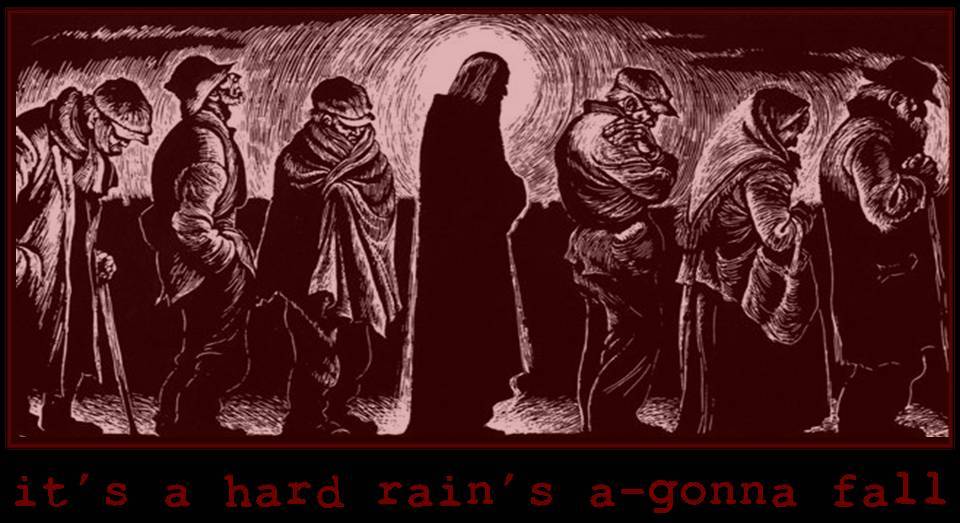
"Christ of the Homeless" (1982) by Fritz Eichenberg
In addition to the ordinary means of fasting by abstinence from meat and reduction in victuals, I'd also recommend trying to make a spiritual offering of the suffering involved in encountering such cold weather - and yes, it is a kind of suffering, and maybe for some of us (depending on various conditions we might have and the like) a greater suffering than for others.

But of course we can also take the opportunity to pray through this experience as well, reminded as we are by this suffering of the cold that there are many more less fortunate who suffer much more terribly, without shelter and proper clothing, dependent upon the charity of others. (And, needless to say, while I won't go so far as to challenge us to go looking tomorrow for an opportunity for charity, I hope we will hold ourselves ready to act upon such an opportunity should it arise.) All of which is to say, there should be no lack of substance for meditation and reflection as we imagine what it must be to lack shelter on days such as this: Hospes eram, et collexistis me (Mt. 25:35).

So, I hope you'll join me in making a special offering of suffering this cold weather tomorrow (Wednesday, January 8th), adding to it prayer and fasting, offering any part of our discomfort through it all up in prayer to God, calling for His generous blessings upon the less fortunate and acting in reparation for whatever sins of mankind might be contributory to making them so unfortunate.

+ A.M.D.G.

Thursday, July 11, 2013

The Motific Overture

Fans of musical theater know how an overture works. Before the play begins, the audience is treated to a tasting of the sundry songs they may hear throughout the piece. In overtures from the likes of Rogers and Hammerstein, these are pretty baldly presented in something like a musical montage, one set-piece after another with sometimes abrupt transitions (a full stop with a boom from the timpani, a crash or a cymbal, or, in The King and I, perhaps a flourish of the gong). But in more sophisticated compositions (such as those of Leonard Bernstein, for example), these themes are interwoven in more subtle ways, becoming musical motifs that will resonate throughout the rest of the play: certain chords that will make a reappearance at crucial points in every song, particular instruments playing a single measure that later comes to be associated with one particular character, and so on. And it's fun once you've experienced the play a first time to note, on a second encounter, how this tightly interwoven foreshadowing in the overture works.

We similarly often reflect back on the careers of great movie directors, or writers, or statesmen, or yes, even Popes, and trace how early overtures can be observed to set out the motifs which in a way become hermeneutics for understanding that individual's legacy.

For Pope Benedict XVI, for example, his coinage of the phrase "dictatorship of relativism" is a monument in his career that helps elucidate his overall project and legacy. So, too, many have seen his famous Regensburg lecture as an important touchstone in interpreting his papacy and his intellectual oeuvre. There are many other examples one could offer.

Anyway, the reason I'm thinking about this today is because - at the risk of foolishly prognosticating - I think we've recently seen Pope Francis introduce one of those motifs in his own 'opening overture'. It's one of those coinages like "dictatorship of relativism" that could become something of a catch-phrase for his papacy: namely, the "globalization of indifference."

Francis introduced this theme in his recent homily at the Mass he celebrated during his visit to the immigrant island of Lampedusa:

Today no one in our world feels responsible; we have lost a sense of responsibility for our brothers and sisters. We have fallen into the hypocrisy of the priest and the levite whom Jesus described in the parable of the Good Samaritan: we see our brother half dead on the side of the road, and perhaps we say to ourselves: "poor soul…!", and then go on our way. It’s not our responsibility, and with that we feel reassured, assuaged. The culture of comfort, which makes us think only of ourselves, makes us insensitive to the cries of other people, makes us live in soap bubbles which, however lovely, are insubstantial; they offer a fleeting and empty illusion which results in indifference to others; indeed, it even leads to the globalization of indifference. In this globalized world, we have fallen into globalized indifference. We have become used to the suffering of others: it doesn’t affect me; it doesn’t concern me; it’s none of my business!
[...] The globalization of indifference makes us all "unnamed", responsible, yet nameless and faceless.
[...]  We are a society which has forgotten how to weep, how to experience compassion – "suffering with" others: the globalization of indifference has taken from us the ability to weep!
In a globalized and information economy, a technocracy in which day-to-day life seems to track at an ever faster pace of chaotic hurry, this sense of anonymity and atomisation increases with every passing year - even though this problem has been complained against and warned about since at least the beginning of the last century (one thinks of poets like Eliot of Auden, for example).

Interestingly, this isolating totalization of inhuman and structural forces above the level of individual or community action which nevertheless impacts the lower levels of society has been seen most graphically in our modern history in totalitarian states (or the fictitious dystopias written about such): in other words, it's striking to me that this "globalization of indifference" is itself a kind of "dictatorship." One wonders: is this just a name for the same complex of phenomena Benedict called the "dictatorship of relativism"? Or are these two things separate facets of larger forces at work within the broader spirit of the age?

In any event, I think this phrase is a fertile source for reflection and perhaps should become a monument in Francis's project moving forward, a helpful remembrance from early in his papacy that might aid us in understanding how things develop from here on out. Even if not, it will still have been a fascinating note sounded in the overture and worth savoring in its own right; and I for one will be thinking about it more in-depth in the days and weeks to come.

Thursday, January 13, 2011

Control Freaks (Not Normal People)

As the news cycles continue to spin absurd tangents off of the tragedy in Arizona, I'm venturing another opinion about an issue which I really think unrelated to the current events but which is the center of much discussion in the wake of them. The issue: gun control.

I'll keep this short.

I am not a member of the NRA. I do not own a gun. I have no inordinate love of guns.

Furthermore, I think that many of the defenders of gun rights give an absurd reading of the second amendment and present a figment of a constitutional right.

There is, however, a common sense approach to this matter which, if overlooked by gun advocates, is even more frequently missed by their opponents.

I have fired weapons in my lifetime. I've shot paper targets and tin cans. Perhaps, in my youth, I once or twice made sport of small birds and mammals with a carefully aimed bee-bee. [I do not doubt that this admission could itself form an inroad to a whole other controversy. Bring it on!] All in all, my experience with firing guns has been entertaining, a sporting affair - even when it was in the context of military training. In the back of my mind, I always prayed I would never have to use a weapon in earnest. I enjoyed the skill of marksmanship, learning my way around the weapons' intricacies, the thrill of the trigger pull after a controlled exhalation. And I've never shot anyone. Never even thought of it.

Now, sure, there's an argument to be made about defense of home and property that a person ought to be allowed a gun in the home. Most moderates (I consider myself, all in all, to be among that political class) will admit this. Ordinarily, the gun control argument gets hairy when someone drops this ballistic bombshell: "There's no reason that somebody needs a whole collection of guns or semi-automatic weapons in the home." And, as far as it goes, this argument is sound: there is, in the pragmatic way of looking at things, no reason. And, according to the same system of evaluation, there are many reasons indeed that such arsenals ought to be "controlled".

But - here's the rub - it all depends on what we regard as most reasonable. It all depends on what we consider to be the reasons - that is, the philosophical causes - that inform our day to day existence in the most profound ways. For me, those reasons are not ultimately the practical and the pragmatic. They are more holistic. In my ideal view of things, man's pleasure is often found in the things that don't have the immediate reason the rationalist looks for: stamp collections, idle walks, improvised whistling, falling in love, joining a political party, shooting a gun at inanimate objects.

Why does a man need a machine gun? I don't know that any man does. But I can think of why a man may want one. If a man likes shooting cans or paper targets, he might like shooting them in a variety of ways. With each weapon comes a different skill, a different pleasure, a different art - art, the quintessential pleasure of man, and what Dante calls the grandson of God. Indeed, there is much in our divinely imprinted nature that shines through in our ability to manipulate machinery to such precise ends, to aim and to cause reactions faster than our physical natures could ever cause without our artifaction.

There are some who will find this a weak argument for non-restriction of weaponry by device class, and I respect their concerns. The truth is that the effect of certain weapons can be very much more terrible when aimed at a living being than other weapons'. However, the aim is the most terrible part. And it is more causally, more philosophically, related to the effect which we all (of course) desire to avoid. The question is whether we want to cede control of a thing which may be used harmlessly and for pleasure because of the perverted individuals who use that thing for pernicion.

This relates, of course, to what I said in my last post about our propensity as a people to respond categorically to aberrations and to try to "control" every aspect of our lives; I've tagged this post with many labels, including subsidiarity, and there is the reason why. We are always and everywhere giving up ordinary freedoms and passing laws to restrict the liberties of normal individuals in order to control against those abnormal few who abuse the gifts of freedom and will. It is a strategy which perhaps is justified in a Kindergarten, but it has no place amongst the affairs of civilized men and women. I need not make any of the slippery slope arguments (which only may be fallacious) about how a restrictive society will continue in its rut; for, if you, dear reader, have not yet felt sympathy for my philosophical appeal, I don't know whether we'll ever come to agree on this.

For my part, I doubt I'll ever start a gun collection: it's cost prohibitive. But I'd like to know that I may do so if I choose - if I win the lottery or get my wits about me and get out of academia so that I can earn money. My aim in doing so, however, would not be to take life, but to give it: to live more vitally, more freely, more artfully, more pleasurably. To shoot with friends at things which there is no harm and all fun in shooting, to feel the rush that it gives, to respect the awful power it represents, to deplore the terrible violence that is its perversion. In short, to revel in controlling what is my right as a normal man to control, and what needs no other to control on my behalf.

Saturday, December 18, 2010

So, What Would Dorothy Day Do?

About a fortnight ago, I posed a question and promised to return to it.

And so, let's get to it. But how?

It would be tempting to start with an invitation, dear reader, that you reflect with me upon the world in which we find ourselves, now nearly a full year into the second decade of the second millennium of the Christian era. But what use is it? I don't know how it goes for you, but for me the reflection overwhelms me almost the moment I've begun. How difficult it would be even to try to catalog the major problems we face, to pick perhaps the top ten maladies plaguing society, and then even tentatively to suggest how Dorothy Day's example might help us in addressing just one of them! How, then, to begin?

Well, in short, not there. We have already been warned against the wrong-headedness of such an approach by the great Chesterton, who called it - in What's Wrong With The World - "the medical mistake":
[T]his scheme of medical question and answer is a blunder; the first great blunder of sociology. It is always called stating the disease before we find the cure. But it is the whole definition and dignity of man that in social matters we must actually find the cure before we find the disease.... The only way to discuss the social evil is to get at once to the social ideal. We can all see the national madness; but what is national sanity? I have called this book "What Is Wrong with the World?" and the upshot of the title can be easily and clearly stated. What is wrong is that we do not ask what is right. [Source]
And so we will undertake a different approach, a positive project: we will outline certain aspects of the example of one modern saint and see whether these qualities suggest anything to us that can be transfered into and emulated in the context of our own age, not so distant from her own. I might suggest certain crises of culture which seem to line up in particular ways with Dorothy's life, but the choice of how exactly and to what extent her own actions apply in a given situation calls for personal discernment and the diligent exercise of prudence.

But here I must take one more tangent. I own that this list is by no means exhaustive; but even with that caveat I know some will disagree with what I have remarked as "essential" to Dorothy Day's character based on my own study of her life and works. I fear this is unavoidable - yet, I will not apologize nor over-correct for the possible disagreement. I cannot enter deeply here into any discussion of where and why I see these features figuring prominently in Dorothy's biography (nor discuss why I choose these particular qualities above others equally worthy of consideration). My main goal is too modest for all that; I am concerned here to explore the usefulness and fruitfulness of our question as a practical one for translating the Gospel in our age. I welcome dispute and conversation on the matter and will happily work to justify my observations at a length in the comment-boxes that would be cumbersome to this main post. [For those who are simply unfamiliar, there are plenty of good resources out there to get started in a study of this fascinating woman's life: here are just a few.]


Today, I offer for our consideration three manners in which Dorothy Day is a modern exemplar of the Christian life and the practice of the Gospel: as a radical, as a personalist, and as a woman with an apostolate.

Dorothy Day: Radical

In identifying Dorothy Day as a radical, I borrow from the wisdom of Archbishop Charles Chaput who recently offered some reflections on her witness to our age on the occasion of the thirtieth anniversary of her death. In his own choice to call Day a radical, the Archbishop returned to the etymological root (pun intended) of the word: "She was radical in the truest sense of the word," Chaput said, "committed to the root of the Christian vocation." She witnessed to the Gospel in season and out of season, and "refused to ignore or downplay those Catholic teachings that might be inconvenient."

Thus we find the first use for our question, "What Would Dorothy Day Do?" It translates into the many situations in which the relation of the Christian vocation to the status quo is one of paradoxism. We might think especially, in our age, of situations which seem to imply a binary choice, wherein neither proposed way seems really consistent with the demands of the Gospel. How often are we choosing "the lesser of two evils" - when do we give into compromise for the sake of social manners and communal comfort? Such are situations which probably call for radicalism.

We may ask, what would Dorothy Day do in political life? Whose "side" would she have taken in the many conflicts which define civic discourse in our age: in the airports, at the borders, outside the abortuaries, across the world from the battle zone? I think that her life gives us clear indications of what she might have done in any of these scenarios; but it does not finally matter so much whether we choose to do exactly as she might have done, rather it is important for us that we, when once we've discerned the way that our vocation seems to indicate, do not hesitate in following through to the radical consequences that may unfold. We need not seek ridicule, strife, indignation, or imprisonment: consequences which Day's social actions earned for her with striking regularity. But when the cause of righteousness seems to lead to these things - which seems more and more likely an event - then we may find a useful measure of the full extent of our call in the radicalism of Dorothy Day. And if the situations of paradoxism plaguing our world discomfort only our minds but do not otherwise affect us, then we may well ask whether we are truly fulfilling our Christian call. If the times call for radical response and we do not give it, who will?

Dorothy Day: Personalist

I have remarked before on how the personalist vision is essential for rightly-ordered social action. I believe that it is, philosophically, the key to unlocking the import of the Catholic Church's Social Teaching.

For those unfamiliar with the concept of Christian Personalism - a response to and development upon Christian Existentialism - I think a useful encapsulation can be found in a teaching by Peter Maurin, Dorothy Day's own tutor in this school. She recounts somewhere (I am paraphrasing) how Peter described "selfhood" as being essential to living in true communion: He said that when any number of "I"s are present - that is, truly thematic selves - then there is a "we", and "we" is the essence of community; where, on the other hand, there is only "they", there is not community but "a crowd".

Crucial to the living of the Christian vocation is finding the other truly as a "self", a fully realized person with whom we are called into relationship. For Day, the importance of this is that the very self of the other is transformed by the Incarnation and by Christ's teaching on the judgment: when we serve others who are hungry, thirsty, naked, imprisoned, we serve Him: and discovering Him in this way is crucial to having true relationship with Him. This is an inimitable aspect of Christian life which prayer and even the sacraments - even the Eucharist - cannot replace. Thus, for Dorothy, the exercise of the Corporal and Spiritual Works of Mercy became essential expressions of the Christian vocation: not merely peripheral concerns or even fruits of some deeper experience of holiness and grace. Christ is waiting to be met in personal encounters with the poor and needy in a way that is necessarily complementary to the manner in which He comes to us through sacrament.

[[It is an interesting side-light on this matter that the present Holy Father's social teaching seems to take a very similar tact to that of Dorothy and Peter Maurin. I have written about the Pope's work here in light of his affinity with the Christian Personalism of Dietrich von Hildebrand. I also treat of an instance in section IV) where, on the unique category of love of neighbor, Benedict seems to go beyond the master's theology; it occurs to me now that the direction he seems to be taking in this respect is really foretokened in the examples of Day and Maurin.]

So, what would Dorothy Day do as a personalist in our age? Where - in whom - would she find Christ waiting for compassion, for respect, for love? Would she wait for Him to come to her, or go to seek Him out? ... which leads us to our next category:

Dorothy Day: Woman of Apostolic Living

Dorothy's apostolicity comes in two categories: word and action.

In Word

Dorothy challenged the orthodoxies of her day with words seeded by the Gospel's teachings. What conversations call for authentic Christian voices in our world today? In her own age, Dorothy published a paper for a penny-a-copy with a pittance of resources. We have unprecedented technological means for spreading the Christian message, for reaching untold audiences at the click of a mouse. On our own Facebook Walls we have, in all likelihood, audiences which numerically equal or surpass the initial subscribing membership of The Catholic Worker. Do we use this to our advantage - rather, to the Gospel's advantage? Do we choose our words to discomfort the smug and comfort the afflicted? Do we challenge with our words? Do we respond to the errors that cross our screens and add our voice to the conversation, or for the sake of anonymity and convenience turn a blind eye?

In Action

Dorothy was not content merely to wait for the challenge of the Gospel to cross her doorstep. She went out and gathered the lost and forsaken. She let her lodgings be overtaken by those in need and found larger ones when she ran out of space so that more could have the advantage of her aid. To our jaded age it may seem she was often taken advantage of. Perhaps she was. But this seemed to her less of a risk than the risk of doing too little, of missing a chance to engage in the apostolate.

The answer to our question here is so vast and varied as to almost seem unhelpful. There are so many ways in which we can help, so many ways in which we can make a difference. We know this much from the Gospel - so how does Dorothy's example really help to elucidate and distill that teaching for us and make it practicable?

I would argue that Dorothy's apostolic action is a useful model for us in its ambition and scope. In the name of humility, and in the name of the virtues of prudence and temperance, it seems that Christians today might let themselves too easily off the hook for simply not doing more that they could. (I should note that here, as in all of the above - in case you haven't realized it yet - I accuse myself first of all!)

This is, again, something I have written about before. In our age excuses are not hard to come by. Furthermore, -and I know this will be one of my more controversial points - it seems more in vogue these days to encourage the ordinary ways of holiness, to call for Christians to be more perfect in their day-to-day lives as husbands and wives, fathers and mothers, businessmen, workers, painters, writers, etc. And, surely, this is needed. But I think we also need to intensify our call for Christians to do more - to go beyond the ordinary, to become immersed in the apostolate in a thorough-going manner, to go to the brink of when it seems they can simply do no more and then give even a little extra.

Perhaps it will seem that we are being taken advantage of, that the needy are bleeding us dry. But, then, perhaps this is the kind of bloodshed called for in this apostolic age, a new kind of martyrdom. And so, rather than asking what action Dorothy would undertake among the many social imperatives that need the work of good Christians, we can ask our question as a measure of degree: when we wonder whether we should do more, we can ask: "What Would Dorothy Day Do?"


I began this series of reflections by looking at the question, "What Would Jesus Do?" The question emblazoned on bracelets adorns the hands of believers throughout the world; what should really be found at the hands of believers is the answer to that question. In the hands of Dorothy Day, that answer was found: hands cuffed in radical action against injustice, hands lovingly stroking the face of a stranger, hands typing the words of evangelistic love, hands serving food to Christ in the breadlines. Ultimately, our purpose in asking our new question is not the question itself: it is the answer we will give: the answer we must give: the answer that reveals how Jesus already had done and continues doing "what He would". He calls us - and sends us forth.

Friday, December 3, 2010

WW3D?

One of the most distinguishing features of Catholicism, when compared with other Christian faith communities, is the Doctrine of the Communion of Saints. In much Apologetics discourse, this seems very often to be the bone of most heated contention.

Many have commented upon and analyzed this point of difference. Most of the discussion I've read seems to focus on the need for intercessory prayer or on the concept of solidarity with Christians who have gone forth from this life. The image of a lit votive candle placed before a statue or a holy card stuck in a car visor are emblematic for many people of Catholics' strangeness, their medieval sentimentality, the "cult" of the Saints. There is another image, though, which - for me - highlights the difference that this quintessential Doctrine makes in living out the Faith of Christ. That image is the W.W.J.D. bracelet.

Now, of course Catholics have been known to wear and to celebrate the mantra on the bracelet, but it is at least somewhat significant that its origins seem to be in Congregationalist writings. Of course, for any follower of Christ, the question is important. But asking, "What Would Jesus Do?", is really only a starting point, it's no kind of end. It is an invitation to reflect, with the next step being to consider more deeply the particulars of any given situation in the aspect of the Gospel; after a first asking of the question, we usually come round again to the very same question, only re-emphasized: "What, indeed, would Jesus do?" That is, in this particular moment, in this set of circumstances which I now confront as a baptized Christian, what is the demand of the Gospel upon my choice of action? And in such questions of praxis, we can see the starting points of many of the divisions which have separated Christian groups throughout history: the question of interpreting the Gospel mandate forms the background of debate over liturgy, mortification, prayer, or Christian Social Action as determined by the Beatitudes and the Spiritual or Corporal Works of Mercy. "What Would Jesus Do?" Good question, and sometimes a head-scratcher.

Christ himself is of course our chief and primary exemplar in learning to be sons and daughters of the Father - nay, really, in becoming part of the One True Son of the Father. For many Christians, no further example seems to be wanted - but here is that point of difference made by the Doctrine of the Communion of Saints upon which I choose to focus. Christ, at His Ascension, promised to give His Spirit and invigorate the Church. The Spirit has sometimes thus been called the Soul of the Church, whose members are the Body. Christ left us a plan for His continued Presence - in the sacraments, the liturgy, etc. - but also for His continued example, in the lives of Saints.

We are given Saints in every time and place in order to have some better idea how to translate into practice the teachings of Christ. This is not a by-route around an intimate knowing of Christ, but simply a recognition of the economy of salvation as He has established it in His Living Body, the Church. His Word is alive and acting - it is not two-dimensional figments on a page, the theological abstractions and minutiae which we spill so much ink (and sometimes blood) in working out. But He comes to us in a Living Word which includes also the font of Sacred Tradition, a three-dimensional reality, constantly demonstrated in new ways and changing times, by the holy men and women whom His Spirit moves to witness to His Truth.

This may all sound very preachy, but it's really finally very practical. Saint Paul, in his letters, never hesitated to hold himself up as an example to his community. Since Christ had gone from their sight, or had never even been seen in the flesh by many of the new disciples, Paul didn't hesitate to give them a yardstick which appealed to the immediacy of their call as Baptized Christians: "Be ye followers of me, as I also am of Christ" (1 Cor. 11:1). "Not sure what Jesus would do? Watch me."

We are Baptized in Christ and bear His Name as Christians. Implicit in the question, "What Would Jesus Do?" is the translated notion of what Christians must do. And we look to the Saints for examples of how, in each era, this question can best be answered: What would Paul do? What would Agnes do? What would Gregory do? What would Francis and Clare do? What would Ignatius and Francis Xavier do? What would Isaac Jogues and Elizabeth Ann Seton do? What would Maximilian Kolbe and Theresa Benedicta do? And - yes - what would Mother Theresa and John Paul II do? They would do - they have done - what Christ teaches through His Spirit to His chosen Saints, to reify in their present actions the Hands of the Carpenter's Son.

And now, all of this being really only a background reflection to prepare for something lately burning in my mind, I will leave you with the question which I signify in this post's title (indeed, in the image at the top of this entire blog): a question to which I'll return pointedly in another post shortly: In this day and age, where the world is gone mad and the choice seems always to be for the lesser of two evils, what would our Lord do? What would he have us do? I think the answer, in part, comes to this: What Would Dorothy Day Do?

Thursday, May 13, 2010

The Distributist's Bookshelf: G.K. Chesterton's What's Wrong With The World

What's Wrong With The World by G.K. Chesterton. ♦♦♦♦ ♠ ♠ ♠ ♠
(San Francisco: Ignatius Press, 1994).
200 pp.


"I have called this book 'What Is Wrong with the World?' and the upshot of the title can be easily and clearly stated. What is wrong is that we do not ask what is right."
- from the first chapter, The Medical Mistake

In 1910, G.K. Chesterton presented to the world this "thundering gallop of theory" because, as he put it in the Dedication, "politicians are none the worse for a few inconvenient ideals." The ideals which he presented for the consideration of both politicians and the man-in-the-street are as provocative and challenging today as they were when the book was first published.

Chesterton divided his book of impractical politics into categories addressing the three major subsets of any polis: men, women, and children. These categories comprise the three central sections of the book: "Imperialism, or the Mistake about Man"; "Feminism, or the Mistake about Woman"; and, "Education, or the Mistake about the Child". Like bookends to these varied discussions, Chesterton addresses in the first section "The Homelessness of Man" and recapitulates in the fifth and final section with "The Home of Man".

Apart from the figures of the man, woman, and child within society, three other characters figure into Chesterton's examination of modern society: Jones, the average man in the street, and his old mortal enemies, Hudge and Gudge, representing the liberal political aristocracy and the conservative respectively. Chesterton introduces the machinations of Hudge and Gudge in section one, demonstrating how their constant give-and-take about what to do with Jones only ends up disenfranchising and alienating Jones from the State which is as much his as it is theirs.

Hence, the homelessness of Jones. Hudge and Gudge, being practical men, set aside "idealism" in order to scrutinize the problem of Jones's poor situation and come up with a practical solution. Hudge builds tenement houses and bustles Jones into them in order to get him out of the ghetto, but his ideal charity ward degenerates into the slum of the modern welfare state. Gudge, reacting against Jones, repudiates the slums with vigor, but soon convinces himself - in support of his indignation - that Jones was better off where he was before and ought to have been left alone in his poor state. And Jones is left to choose between the poverty of abandonment and the poverty of degradation. "[T]he mistakes of these two famous and fascinating persons arose from one simple fact," Chesterton says: namely,
that neither Hudge nor Gudge had ever thought for an instant what sort of house a man might probably like for himself. In short, they did not begin with the ideal; and, therefore, were not practical politicians.
When, in his final section, Chesterton returns to Hudge's and Gudge's parsimonious practical politics, he proposes a theory which should give modern readers pause as they contemplate the binary political calculations to which we are reduced every election day:
And now, as this book is drawing to a close, I will whisper in the reader's ear a horrible suspicion that has sometimes haunted me: the suspicion that Hudge and Gudge are secretly in partnership. That the quarrel they keep up in public is very much of a put-up job, and that the way in which they perpetually play into each other's hands is not an everlasting coincidence. [...] I do not know whether the partnership of Hudge and Gudge is conscious or unconscious. I only know that between them they still keep the common man homeless.
The lack of idealism resulting in this age-old conflict also gives rise to the specific problems relating to men, women, and children. In the case of Man, the ideals of patriotism, comradeship, of self-rule and equality, give way to another poisonous philosophy, one which manifests itself in Imperialism and Social Engineering. Chesterton rails in one instance against the obsession with "hygienics" which was in vogue in his day, but we can easily see in this instance hints of our own current welfare projects: the tyrannical war against personal choice of lifestyle and health, the removal of table salt from restaurants, etc. Chesterton boils it down into what he calls "the huge modern heresy of altering the human soul to fit its conditions, instead of altering human conditions to fit the human soul."

In the case of Woman, the ideal of the domestic woman, Queen of her domain, gives way to a lesser ideal with the ironic pretense of trying to achieve something greater. The ideal of Woman becomes en-masculated and adopts ideals meant for men, which only serves to degrade the potential of women. A specific instance Chesterton uses here is the example of women's suffrage. One might take exception to his particular characterization, but one cannot deny the veracity behind his observation of the philosophy underlying the suffragist movement.
[T]here has happened a strange and startling thing. Openly and to all appearance, this ancestral conflict has silently and abruptly ended; one of the two sexes has suddenly surrendered to the other. By the beginning of the twentieth century, within the last few years, the woman has in public surrendered to the man. She has seriously and officially owned that the man has been right all along; that the public house (or Parliament) is really more important than the private house; that politics are not (as woman had always maintained) an excuse for pots of beer, but are a sacred solemnity to which new female worshipers may kneel; that the talkative patriots in the tavern are not only admirable but enviable; that talk is not a waste of time, and therefore (as a consequence, surely) that taverns are not a waste of money.
Thus, according to Chesterton, the modern Woman has abandoned her role of the Universalist, the Queen of a much larger domain within the domestic household, for an ancillary role in the much smaller domain of the larger State.

Finally, in the case of the Child, Chesterton observes that modern education has gone wrong by trading in the ideals of Tradition and Authority for trendy scientism and novelty. He says, "It ought to be the oldest things that are taught to the youngest people; the assured and experienced truths that are put first to the baby. But in a school to-day the baby has to submit to a system that is younger than himself." In education, says Chesterton, there's a certain "need for narrowness," a discernment. The modern educator dissembles the fact that he is indoctrinating youth by indoctrinating them with the firmest and most stifling dogma that was ever known: namely, the impossibility of dogmatic fact. And so the modern educator abandons "the true task of culture," which is "not a task of expansion, but very decidedly of selection — and rejection. The educationist must find a creed and teach it." This is an inescapable practical fact; the educator, whether he would or no, instills fundamental attitudes about the world into his student, which take the form of a practical creed in discerning facts about the universe. Chesterton simply suggests that the broadest of such attitudes - which also happen to be the oldest, classical postures - ought to be the ones used.

To the Distributist reader today, some of Chesterton's examples and the exact issues he chooses for debate may seem antiquated. But his project of discernment, and his fundamental distinction about the practicality of idealism is an ageless sentiment, and one which ought to be brought to every debate about politics today. Every Distributist should have this work on his shelf and return to it often, in order to absorb the spirit of that project into his own worldview, to begin viewing the world as Chesterton did - with clarity and insight, and with a solidaristic love for Jones.

Monday, May 3, 2010

Who Is My Neighbor?

Now the whole parable and purpose of these last pages, and indeed of all these pages, is this: to assert that we must instantly begin all over again, and begin at the other end. I begin with a little girl's hair. That I know is a good thing at any rate. Whatever else is evil, the pride of a good mother in the beauty of her daughter is good. It is one of those adamantine tendernesses which are the touchstones of every age and race.
G.K. Chesterton
The preceding passage is taken from one of the most stirring and rhetorically brilliant passages in all of Chesterton's writing. It is a brief chapter at the end of a too-brief book. You can read the entire passage here. When you're done that, you really should read the whole book. When you've done that, why not attend a conference on the book to learn more?

In an earlier post, I spoke about the ramifications for our spiritual lives of the Gospel's teaching that we "belong" to Christ, and, by extension, to one another. I promised to come back to the subject and relate its meaning to our socio-politico notions.

The Parable of the Good Samaritan (Luke 10:30-37) is often used in addressing issues of social justice, and rightly so. It should be borne in mind that Christ's parable is addressed as an answer to the question, "Who is my neighbor?" We tend automatically to think of the poor man beset by robbers who receives the service of the Samaritan as the "neighbor." But, when Christ reiterates the question at the end of the parable, he asks which of the three passers-by - the Pharisee and Priest who ignore the man's plight, or the Samaritan who shows mercy - are neighbor to the afflicted person. The Good Samaritan is the neighbor in answer to the question.

This, then, begs the question: why were the priest and the teacher not neighbors to the wounded traveller? The answer lies in their choice not to commiserate with his sorrow and enter into relationship with him. Their coldness was a result of their attentions to other precepts of ritual purity which took precedence over the command to help the migrant man left in the ditch at the side of the road by brigands. The translation of Christ's answer, then, is not that "neighbors are people who help us" - remember that the question had been asked in the first place as a means to interpreting the command to love one's neighbor. Christ's answer, we must say, is indirect. It answers the question of who neighbor is by answering the more ultimate question of what neighborliness consists in. The command to love one's neighbor contains all of the information that the questioner needed: love is what creates neighborhood. Love draws person to person and establishes relationship. Love of neighbor does not need a qualifying question to answer who neighbor is: when love reigns, the lover sees his neighbor and, seeing him with love, he does what a good neighbor ought to do.

An important point to remember, here, theologically, is that the command to love God fully is placed first. This, then, becomes the basis - theoretically and formally - for the love of neighbor. For love of God will actually beget the virtuous disposition of charity - or, if you like, infuse it - in the believer. This disposition then serves as the answer key for finding a neighbor and responding according to the command to love.


Now, the upshot of this, following from the previous post, is that our social order needs to be one in which this disposition can realistically become the basis of personal action. In the engagement of every social work, including our economic service, human beings must be able to realize this potential which is begotten by the theological virtue of love.

And this has consequences for how we organize the relationships we have in society and the economy. We must remember that the human person is at the beginning and end of all our work in these matters. When we become too abstract, speaking about the migration of peoples as a labor force, or as laborers as an aspect of economic capital, or as the roles of people within society as their determinative value or worth to the social good, we do so at our peril. Economic rationalization has its place. Abstract theory of government and the rhetoric of policy have theirs. But all of these things are at the service of the ultimately important things, the human things.

A social order's efficiency and value may be seen in terms of what can be accomplished and achieved. But the matter of how things are achieved and who achieves them is even more important to consider. People need a space in which they can have the vision that love demands: a vision directed toward human ends, toward the good for themselves and the good for others.

This should be a staggering thought for us to consider. I'm not saying that I know the necessary ways to transition to a more personalistic atmosphere for modern society, but I know that the Church's Social Teaching demands us to consider it. Think of the line in the supermarket, the stands at the major sporting event, the traffic jam on the freeway, or the cubicle in an office building: maybe a lot like that road to Jerico. The end of the road might be the commercial city, or a mis-placed sense of civic, economic or even religious duty. But our way is strewn with real people, real people who would be loved - regardless of whether or not they'd love in return. And it's our job, it's the whole purpose of the love God gives us, to see them fully, to become neighbor to them by considering them under the aspect of a full personalist humanism, and if necessary by rendering them a service in charity.

The difficulty of this excercise should sober us. But it's also worth considering whether it needs to be so difficult, or how it might be less so. In our earlier post, we looked at how our membership in the Mystical Body of the Church bears a mark of personalism by our individual recognition within the unity to which we are ordered. We are called to communion, yes, but we are called by name - the name we are marked with at the same time as our marking with the sign of the Cross in Baptism and our "being claimed" for Christ. We retain that mark of individuality and it's what enables us to be in real relation with others, to belong to them while still being ourselves.

And so, another question that must confront us and that should inform our consideration of social ethics is how we enable people to become truly "thematic" to one another (to borrow a term from the personalist philosophers). What this means is that people need opportunities to excercise their humanity, their full activity of reason and will, their talents, quirks, and even just to be seen and felt in their fleshly individuality. To the extent that this thematicity is diminished, it becomes harder to become neighbor to one another - we're missing the spur that drives loves on, that awakens it in the heart of the lover and draws him to the other.

So, there we have reached the answer to our question - and it is, paradoxically, no more than a more fundamental question. Just as Christ's parable sort of threw the question back upon the questioner and made him look in the law of love to discern whether he was a good neighbor to others, so must we return to the basics and find a new beginning to looking at the social order. Let's start where Chesterton did: with our neighbor.

Saturday, March 27, 2010

A Welcome British Invasion

Last Monday, I had the opportunity to hear Phillip Blond of Res Publica deliver a lecture at Villanova University about the future of Western politics, "After the Market State." The University has just published videos of the event, which I am pleased to post here:


Meeting Our Membership Goals

You may be a construction worker working on a home,
You may be living in a mansion or you might live in a dome,
You might own guns and you might even own tanks,
You might be somebody’s landlord, you might even own banks

But you’re gonna have to serve somebody, yes indeed
You’re gonna have to serve somebody,
Well, it may be the devil or it may be the Lord
But you’re gonna have to serve somebody.
- Bob Dylan
When Anthony Card. Bevilacqua, Archbishop Emeritus of Philadelphia, retired, he took up residence at Saint Charles Seminary. It was not uncommon for seminarians to meet him walking the halls. Looking with consideration at them from beneath his bushy eyebrows, he would sometimes ask, "Are you one of mine?" - by which he presumably meant to find out whether it was a seminarian who had been accepted to Philadelphia during his term as Archbishop.

The amusing question became a popular joke among the seminarians, but few ever stopped to consider the rather profound ecclesiastical implications behind its unconventional wording. The Shepherd had a sense of real possession over the members of his flock and his phrasing evinced this theological posture.

The mystery of membership in Christ's Body is one which provides for copious reflection. Indeed, the concept of personal identity is radically different for the Christian than for any other kind of person: the defining question in Baptism changes from "who we are", as the individual dies in the sacred waters and is claimed for Christ through the power of resurrection, and thenceforth the matter becomes a question of "whose we are" - we belong to Christ, living as members of His Mystical Body, the Church.

Our understanding of the social order ought to be framed by the theological import of this ultimate relation. The simple dialectic between the radical individualism of Western liberalism, on the one hand, and the depersonalizing solution into an absolute Social State, on the other, fails adequately to cope with this ontological transformation brought about by the Incarnation.

Even in the Christian tradition, the popular interpretation of the social Gospel has been insufficient in this regard. I'm thinking particularly of the work of Prof. Michael Novak, who sees something analogous between the ideal of the American market economy and the mystery of the Mystical Body.

The problem seems essentially to be that Paul's discourse on the Body in 1 Corinthians 12 lends itself to an organismic interpretation. Although this idea is by no means explicit in the Apostle's words, one can easily see how someone might begin to understand "membership" in the social order as a functional reality, with the different parts performing their specific roles as members or organelles of an organic whole. Yet, it is important to realize that the Body of which Paul speaks is a unique kind of Body. It is not merely metaphorical, true; but our understanding is problematic when the interpretive hermeneutic begins from the biological reality of the human body as we know it, and proceeds thereby toward an understanding of Paul's teaching. Rather, Paul's teaching is to be itself an interpretive key to other aspects of the Revelation in Christ, and vice versa. Taken in such a way, the guidelines for understanding the symbol become more cogent.

Number six of Lumen Gentium contains a taxonomy of metaphors from Revelation with the Body of Christ as foremost, but all of which are contingent for a full understanding of ecclesiology (and, by extension, these formulae condition our interpretation of the Church's evangelical mission with regard to the social order). The Church is a sheepfold with Christ as the one door; She is a flock to whom He is the Good Shepherd; She is a fecund land, a vineyard, "the tillage of God"; She is the building of God with Christ as cornerstone; She is "mother" and the "spotless Bride of the Lamb"; and She is finally the Body of which Christ is head. The document then goes on to speak extensively of the Church as the holy People of God, "a nation of Kings and Priests," with Christ himself as the High Priest.

The vision imparted by this rich tapestry of symbolism is not easy to summarize, but the major outline might be said to be one of distinction within unity. The individual is not annihilated by the role of service, but rather fully realized and actualized by the very "belonging" - again, the question is best put in terms of "whose" we are: into whose flock we have been cordoned, onto which building we have been built... and so on. However, the question is certainly not one of function. The gifts and charisms which are committed to the individual parts are secondary to the primary identification established by the ordering of the whole to its end. These aspects do not define the members in themselves, but are ordered to the service of the same ontological reality to which the members are ordered as persons, namely Christ. Put another way, all individual services and ministries, vocations and callings, are contained within the basic Baptismal call to holiness and relationship with Christ.


Now, the Church's proclamation of the Kingdom of God contains as an essential element the building up of a more just social order. And since this mission of the Social Gospel is nothing more than the extension of Christ into the world, it follows that the same kind of formal structure applies to that message as the one we've seen defining our ecclesiological ordering.

In a forthcoming post, I will speak about the shortcomings of a too-functional view of social justice. I will try to demonstrate that the same dual integrity of distinction and unity must apply to the social order as applies to the Body of Christ as a sacramental reality. Only in this way is the ordering of society truly analogous to the Mystical Body. It is not something brought into being by diversity of function and roles, but rather something primary to which any diversity of function and roles is contingently ordered. Finally, I will try to show that personal realization - what in the order of the Church is the "calling by name" of each sheep in the flock, the Baptismal claiming of each particular member for unique relation to the end - is just as crucial in the ordering of a just society, which is sadly lacking in our current arrangements which relegate economic players to the position of functional technicians rather than fully thematic persons.

Wednesday, March 17, 2010

A Quick Note...

... to direct your attention to two wonderful catechetical utterances by the Holy Father during these past few weeks. The first, his Angelus message from the Second Sunday of Lent, coincides remarkably with the little reflection I offered here on that same occasion. In short, the Holy Father recognizes a focus of eschatology in the significance of that event:
[T]he Transfiguration reminds us that the joys sown by God in our life are not the destination, but they are lights that he gives us on the earthly pilgrimage...
Recently, the Holy Father has been offering a series of catecheses on the figure of Saint Bonaventure. The third one, published today, is particularly remarkable. Since it is short, I reproduce it here in full:
In our catechesis on the Christian culture of the Middle Ages, we turn once more to Saint Bonaventure. Bonaventure was a contemporary of Saint Thomas Aquinas, and the two great theologians reveal the rich diversity of the theology of the thirteenth century. Whereas Thomas saw theology as primarily a theoretical science, concerned with knowing God, Bonaventure saw it as practical, concerned with that “wisdom” which enables us to love God and conform our wills to his. Thomas’s emphasis on truth complements Bonaventure’s emphasis on love within the unity of a great common vision. As a Franciscan, Bonaventure reflects the primacy of love embodied in the life of Saint Francis. He was also deeply influenced by the theology of Pseudo-Dionysius, with its emphasis on the heavenly hierarchies which serve as steps leading the creature to communion with the Triune God. Pseudo-Dionysius also inspired his reflections on the darkness of the Cross, where, in the ascent of the mind to God, reason can go no further and love enters the divine mystery. As a great master of prayer, Bonaventure invites us to let our minds and hearts rise from the contemplation of creation to rest in God’s eternal love.
The Holy Father's Lenten "project", if you will, has a coherent strain of attention to the final end of man and the "practicality" of the Gospel and love of God.

I think this is worthy to reflect upon especially as it bears significance for the understanding and implementation of the Social Doctrine of the Church. It is precisely the dimension of Divine charity which is the most practical thing in terms of transforming our own lives to configuration to Christ, and, by extension, transforming the world into the Kingdom of the Social Reign of Christ. Knowledge, the Thomistic focus, is complementary to this: for he who knows better loves better.

Economics and politics can often become very rationalistic fields, even amongst confessing people. Those who would try to apply the Doctrine of the Church, or the tenets of Distributism (one school of interpretation of said doctrine) would do well to meditate on the practicality of charity. I personally think that understanding Benedict's ideological formation, especially the influence of Bonaventure and also of personalist philosophy, helps to elucidate his teaching in his most recent encyclical. The obsession with the "rationalization" of the economy must be placed squarely within a human context where love is seen to be the highest and ultimate end of man: the logic of love, more than cold numbers and mechanisms of scale, is the decisive determining factor for how we live our lives as individuals in communion.

Monday, March 15, 2010

Freedom Ain't Cheap - and Cheap Ain't Free

Nobody living can ever stop me
As I go walking that freedom highway.
Nobody living can make me turn back;
This land was made for you and me.

This land is your land, this land is my land,
From California to the New York Island,
From the redwood forest to the gulf stream waters,
This land was made for you and me.
- Woody Guthrie
Americans love freedom. We celebrate it in all our songs, wear it proudly as a badge as we parade in defiance of the world. But too few of us know what it really means.

Freedom is a potency. It is necessarily bound up with the power to act. It contains in it the possibility of action, of moral choice. Freedom implies a properly ordered pursuit of a good end - that is, a choice among goods which are duly directed to be goods for the individual choosing and which at least do not interference with goods destined for man in general (i.e., moderated by the objective of the common good as well as the universal destination of goods). When one's pursuit of a legitimate good, the attainment of which would do no one else harm, is arbitrarily restrained - and, consequently, the choices left to him are for lesser goods or even no good things - then, his freedom has been compromised.

This occurred to me the other night as I viewed the documentary Fresh at a local community gathering. Food, one of the basic natural goods of man, is one for which Americans have a scant amount of freedom left to choose.

The decision to buy local, healthy, organic produce is extremely difficult for some people. Often, it can be cost prohibitive. It always requires a degree of perspicacity that can be straining for someone working a full week, trying to service debts and raise children and take care of the sundry duties that go along with owning (or, more often, mortgaging) a home. Instead, most of us fall uneasily back into convenience. We shop at BigBox Mart for high-fructose corn-syrup laden goods produced by large agribusinesses heavily subsidized by the government. Rich in additives and impoverished in nourishment, the food stuffs offered us by our manufacturers of culture are a motley assemblage of promiscuous produce, packaged and shipped from all ends of the earth with copious toxic chemicals intended to kill the lethal bacteria that nevertheless increasingly turn up like bad pennies.

We take our lack of choice on the chin, blind to the threat to our freedom, namely that the seeds which grow our veggies and the grain which feeds our livestock are monopolized commodities that keep squeezing the market into thinner and thinner corridors - as we grow fatter and fatter. The names of our consumables and their shiny packaging belie the fact that there's little more variety to our diet than the often parodied slop-meals offered to inmates of the most austere prisons. We free men accept our three squares and return to our cots with indigestion at best, allergies aplenty, and even the occasional bout of salmonella poisoning. The hidden costs of our cheap convenience are chains upon our freedom, and they are a bitter price.

But there is another way. Agrarian reform is underway in America beginning - fittingly - at the grass-roots level. Farmers and communities of concerned consumers are finally beginning to break the chains of our surreptitious enslavers. And we can all become a part of it.

If you have some spare time and spare change, spring for a copy of the movie "Fresh". Get a few neighbors together to watch the movie, and then discuss what you can do to regain some freedom for food.

Start small. Pool some money between you and your neighbors, and support a local CSA. Get together once a week or every two weeks and have a dinner with your shared produce, and taste the difference freedom makes. Plant a garden with some cooperative labor amongst your friends and dole out the harvest. Put in a compost bin and take turns in managing the layers, and collect your refuse to replenish the soil.

It might not save you any money. It might even cost a little more than the convenience to which we've become accustomed. Anyway, some things are beyond the worth of money to buy. Freedom isn't cheap. But bought dearly, it is a value to be savored, and will surely make you hungry for more.

Wednesday, March 10, 2010

Freshening Up

Tonight I am going to be attending a screening of the movie Fresh at the local Swarthmore Co-op. There will be a discussion opportunity and hopefully a chance to find out more about what the Co-op is doing as a model for community supported agriculture.

Whatever our thoughts on environmental activism, a sustainable and localized food economy is a necessary step toward a healthy, human-scale economy. I'll be blogging after the movie more about this subject. Stay tuned.

Thursday, February 4, 2010

The Distributist's Bookshelf: Henry David Thoreau's Walden

In A Week on the Concord and Merrimack Rivers / Walden; Or, Life in the Woods / The Maine Woods / Cape Cod (Library of America) by Henry David Thoreau. ♦♦♦♦♦ ♠ ♠
(New York: Literary Classics of the United States, Inc., 1985).
pp. 321-587


"I went to the woods because I wished to live deliberately, to front only the essential facts of life, and see if I could not learn what it had to teach, and not, when I came to die, discover that I had not lived.... I wanted to live deep and suck out all the marrow of life..."
- Thoreau, What I Lived For
In 1845, Henry David Thoreau took to the woods near Concord, Massachusetts with the goal "to live deliberately." He meticulously recorded the practical exigencies of his experiment and set them down in several hundreds of words which are amongst the finest prose ever composed in the English language. Whether or not Thoreau succeeded in his Quixotic experiment, he certainly did succeed in crafting one of the finest and most beautiful books ever written by an American.

It may seem a similarly Quixotic experiment to make Thoreau's treatise a hallmark of the ideal Distributist's Bookshelf. His philosophy of transcendentalism, for example, is rather at odds with the traditional metaphysical axiology of distributist thinkers like Belloc and Chesterton. His romantic notions of ideal pagandom and his fetish for Oriental wisdom would fain have met Belloc's approval, if quoted to him over a beer in a homely British Inn. But let's take a look at Walden and see why I think it deserves a place in every truly humane reader's library.

A good place to start is Thoreau's discussion of Economy. In the first chapter of his book, he outlines the "necessaries of life for man" which include "Food, Shelter, Clothing, and Fuel" (332). He distinguishes these from luxuries, which he says are not merely unnecessary, but often times positive distractions from more important things (334). He continues, in the same place,
When he has obtained those things which are necessary to life, there is another alternative than to obtain the superfluities; and that is, to adventure on life now, his vacation from humbler toil having commenced... (op. cit.).

Thoreau embraces the ideal of leisure. He observes that once man has taken care of the essentials of life, he should look at his freedom from want as an opportunity to contemplate higher things, rather than a chance for getting surplus wealth. Yet, this latter object is what he found occupying most of his contemporaries: "The mass of men lead lives of quiet desperation" (329). This desperation is largely due, Thoreau contends, to the industrial system, which begets a cyclic obsession with wealth, rather than true value:
The mass of men... are discontented, and idly complaining of the hardness of their lot or of the times, when they might improve them. There are some who complain most energetically and inconsolably of any, because they are, as they say, doing their duty. I also have in my mind that seemingly wealthy, but most terribly impoverished class of all, who have accumulated dross, but know not how to use it, or get rid of it, and thus have forged their own golden or silver fetters (335).
Now, this is an observation which the distributist critique of modern economy certainly shares. Thoreau's ideals may differ; he may have given his contemplative energies over to principles with which we do not sympathize. But he speaks to the fundamental drive in man to look beyond the merely material for more important things. His view of work and labor are, in the main, somewhat problematic. Sometimes, he seems only to view pejoratively the Divine mandate to "till the earth," which we know is a holy and meaningful occupation. Yet, even here, there is a point of contact with distributist principles. Thoreau is grappling with that special punishment which God selected for Adam after his fall in Eden: that he would henceforth only bring forth his food from the soil "by the sweat of his brow" (Gen. 3:19). The end of human labor is not in itself, but only meaningful within the context of a fully Christian anthropology, which takes into account the restorative power of grace. But Thoreau grasps that there is something deeper and beyond mere toiling.

Thoreau's complaints with the modern life do not stop there. He moved into relative isolation in order to commune with Nature. The hustle and bustle of modernity, for him, was disruptive to meaningful communion, as he explains in his chapter on solitude:
What sort of space is that which separates a man from his fellows and makes him solitary? I have found that no exertion of the legs can bring two minds much nearer to one another. What do we want most to dwell near to? Not to many men surely, the depot, the post-office, the bar-room, the meeting-house, the school-house, the grocery, Beacon Hill, or the Five Points, where men most congregate, but to the perennial source of our life, whence in all our experience we have found that to issue, as the willow stands near the water and sends out its roots in that direction. This will vary with different natures, but this is the place where a wise man will dig his cellar... (428).
Once more, that Thoreau found his own roots to be in a romantic deification of nature is surely not an agreeable end to the argument. But he starts out on the right path. He knows what Chesterton called "the homelessness of man." The agrarian ideal of many distributists, the movement "back to the land," is similar in its pursuit of this "perennial source of our life." Thoreau's cabin in the woods is the place where he goes in order to find himself: it is typical of that place which Chesterton describes in his essay, The Surrender of a Cockney: "Every man... has waiting for him somewhere a country house which he has never seen; but which was built for him in the very shape of his soul. It stands patiently waiting to be found... and when the man sees it he remembers it, though he has never seen it before."

Many other specific ideas and virtues of Walden might be referenced: its cunning ctiticisms of industrial squalor, its celebration of the value of home and homestead, its wry sarcasm about the many material possessions which man uses to prop himslef up (literally - in one place, Thoreau offers a wonderfully amusing satire on furniture: "Furniture! Thank God, I can sit and I can stand without the aid of a furniture warehouse") (see 374).

The greatest asset of Walden, however, is hard to put into words. It is its very ethos. The sheer beauty of Thoreau's prose is in some places literally enough to move one to tears of empathy. His descriptions of crickets chirping, or the sun rising, all the sundry wonders of creation which modern man takes so much for granted - these are the crown jewels of Walden. If not a single ethical principle articulated as such finds its way home when one reads the book, he shall still be somehow a better man for having poured through its pages - or rather, had them poured into him. For Thoreau's liquescent sentences speak directly to the romance in the heart of man which Chesterton knew to be the practical form of reverent awe and wonder. A distributist should return to the pages of Walden often, if only to re-sensitize himself to the miraculous renewal of creation that happens in each moment of every day: the budding of every flower, the falling of every snowflake.

Somehow, this ethos behind Walden is the ultimate communication of its words to the reader, and perhaps no digest is possible. Even Thoreau himself, a peerless master of our language, found it difficult to convey summarily this finding of his own practical experience. So, I shall end at a loss for words, and allow the author one final attempt of his own:
If the day and the night are such that you greet them with joy, and life emits a fragrance like flowers and sweet-scented herbs, is more elastic, more starry, more immortal—that is your success. All nature is your congratulation, and you have cause momentarily to bless yourself. The greatest gains and values are farthest from being appreciated. We easily come to doubt if they exist. We soon forget them. They are the highest reality. Perhaps the facts most astounding and most real are never communicated by man to man. The true harvest of my daily life is somewhat as intangible and indescribable as the tints of morning or evening. It is a little star-dust caught, a segment of the rainbow which I have clutched (495).