Showing posts with label Solidarity. Show all posts

Tuesday, March 25, 2014

"The dragon wishes to devour 'the child brought forth'"

Today has been an interesting day watching social media, as dueling opinions met both inside the chambers of the Supreme Court and outside on its steps to discuss whether people of faith in America should be forced by the government to compensate for morally objectionable services through the health care provided to their employees.

First, on social media, the ACLU and others declared their stripes by way of allusion to the 'Occupy' movement - because the politics of class war and race war and #waronwomen are all out of the same rule book:

The folks at Alliance Defending Freedom - the firm representing the Hahn family's Conestoga Woods Specialties, one of the two companies in court today against the mandate - came back with this clever riposte:

The sloganeering of the day was an interesting facet, with the trending tag #NotMyBossBusiness carrying most of the pro-abortion and pro-contraception messaging... which kind of annoyed me on a couple points: because, well, #NotMyBossBusiness is #NotGrammaticalCorrect; and...


Despite bad weather outside of the Supreme Court, both sides were out in force. Perhaps the Instagrammish filter over this image from the Center for Reproductive Rights (don't get me started) was meant to lure people out because, wow look it's like sunny:

The prerequisite crass signs were on display, too (and happily spread around the internet by Planned Parenthood):

And the hand-in-glove relationship between the gay rights community and the pro-abortion lobby - a phenomenon which demands greater discussion and reflection - was also evident:

And there was this gal, very proud of her sign evidently. ["Psst: You forgot to add, between 'crafts' and 'cabinets,' a checked box for 'employing your ass at a decent wage in the first place when neither you nor they have been forced into that arrangement.'"]

But there were, as I said, plenty of folks were out from both sides.

I created and posted this image on Facebook earlier today because what it says seems to me strikes to the heart of the issue: This is an issue that impacts us all! We're all the Defendants now.


And I wasn't the only one reasoning thus... (and kudos to the #ReligiousFreedomForAll organizers or whoever made these signs which very nicely counter the "not my boss's business" meme):

But above all, it was good to me to see - on this Feast of the Annunciation - that prayer was a part of the demonstrations, because prayer is very much needed in this fight.

Prayer is needed because, as Blessed John Paul II reminded us in his encyclical Evangelium Vitae - first published exactly 18 years ago today - the fight is not just between flesh and blood, but involve higher (and lower) realities:
Mary thus helps the Church to realize that life is always at the centre of a great struggle between good and evil, between light and darkness. The dragon wishes to devour "the child brought forth" (cf. Rev 12:4), a figure of Christ, whom Mary brought forth "in the fullness of time" (Gal 4:4) and whom the Church must unceasingly offer to people in every age. But in a way that child is also a figure of every person, every child, especially every helpless baby whose life is threatened, because - as the Council reminds us - "by his Incarnation the Son of God has united himself in some fashion with every person". It is precisely in the "flesh" of every person that Christ continues to reveal himself and to enter into fellowship with us, so that rejection of human life, in whatever form that rejection takes, is really a rejection of Christ. This is the fascinating but also demanding truth which Christ reveals to us and which his Church continues untiringly to proclaim: "Whoever receives one such child in my name receives me" (Mt 18:5); "Truly, I say to you, as you did it to one of the least of these my brethren, you did it to me" (Mt 25:40).
While what was ostensibly being discussed - at least in the courtroom - today was a question of constitutional rights and authority, the real matter cuts much deeper:  Quid est homo? What is man? What is he for? What does our nature, our sexuality, the special union of man and woman that creates new life really mean for us? And what does it mean when we misuse that nature?

These are questions which we all need to ponder more deeply - some of us very direly.

It is sad to see the Gospel of Life rejected by so many, especially by those invited to fullest communion with Christ's Mystical Body through membership in His Holy Church. Christ Himself is that Gospel, is that Word of Life - something we are reminded of so profoundly as we reflect on the very beginning of it all, the Angel's visit to Mary. But the forces of the Evil One are seeking to destroy that Truth, to silence or distort the Word of Life. With God's grace, it is for us, His disciples, His messengers, to snatch that precious word from the clutches of the dragon.

So may we all strive to do better in proclaiming that Gospel, and doing the Works of Mercy - such as instructing the ignorant, counseling the doubtful, and admonishing the sinner. But let us, most of all, lift up to prayer those who have wandered astray or who are lost, that they may be converted to the Truth and so come into eternal life.

O Mary, bright dawn of the new world, Mother of the living, to you do we entrust the cause of life. Look down, O Mother, upon the vast numbers of babies not allowed to be born, of the poor whose lives are made difficult, of men and women who are victims of brutal violence, of the elderly and the sick killed by indifference or out of misguided mercy. 
Grant that all who believe in your Son may proclaim the Gospel of life with honesty and love to the people of our time. 
Obtain for them the grace to accept that Gospel as a gift ever new, the joy of celebrating it with gratitude throughout their lives, and the courage to bear witness to it resolutely, in order to build, together with all people of good will, the civilization of truth and love, to the praise and glory of God, the Creator and lover of life. -- Bl. J.P. II
Mary, Mother of Jesus Christ, Who is Life itself: Pray for us. 

Saturday, January 18, 2014

Why I March: Because of Her

[W]e are facing an enormous and dramatic clash between good and evil, death and life, the "culture of death" and the "culture of life". We find ourselves not only "faced with" but necessarily "in the midst of" this conflict: we are all involved and we all share in it, with the inescapable responsibility of choosing to be unconditionally pro-life.
 - John Paul II, Evangelium Vitae 28

Tuesday, January 14, 2014

Is the Jury Still Out on Vaccines?

Recently on Facebook, I posted an article regarding the new trend of anti-vaccination and offering a rebuttal. It was a pretty poor article, I realize in hindsight, and I'd only skimmed it at the time. But I posted it in the interest of getting a conversation going. It, er... well, it worked, let's just say.

A lot of people posted a lot of things; some facts and documentation on both sides combined with anecdotal and authoritative experiential accounts, also on both sides. As with the original article, I sloppily skimmed all this material, and now (as with the original article) I'm hastily posting my own thoughts on the matter. I am, if you haven't noticed, A Guy With A Blog.

Tuesday, January 7, 2014

Quick Invitation and Call to Prayer

If you're at all like me, you may have groused, groaned, mumbled, grumbled, or even uttered an oath upon stepping out of doors into the extreme cold these past couple days.

I don't guilt myself with that, nor do I think you should, but I do see an opportunity in it for growth in virtue and for efficacious prayerful offering. And so that's what I'm going to do, and I decided I'd invited you to do the same.

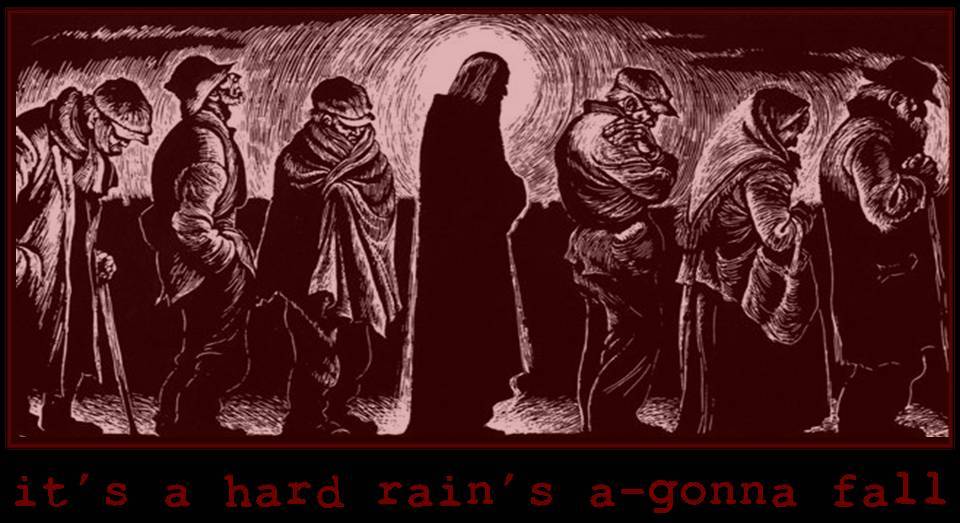
As Wednesdays are a traditional day of fasting and penance anyhow, and as it will still fall at least somewhat in the cold snap for most of us here in America, I'm inviting my friends and readers to make tomorrow, Wednesday, January 8, a day of fasting and prayer for the less fortunate.
"Christ of the Homeless" (1982) by Fritz Eichenberg
In addition to the ordinary means of fasting by abstinence from meat and reduction in victuals, I'd also recommend trying to make a spiritual offering of the suffering involved in encountering such cold weather - and yes, it is a kind of suffering, and maybe for some of us (depending on various conditions we might have and the like) a greater suffering than for others.

But of course we can also take the opportunity to pray through this experience as well, reminded as we are by this suffering of the cold that there are many more less fortunate who suffer much more terribly, without shelter and proper clothing, dependent upon the charity of others. (And, needless to say, while I won't go so far as to challenge us to go looking tomorrow for an opportunity for charity, I hope we will hold ourselves ready to act upon such an opportunity should it arise.) All of which is to say, there should be no lack of substance for meditation and reflection as we imagine what it must be to lack shelter on days such as this: Hospes eram, et collexistis me (Mt. 25:35).

So, I hope you'll join me in making a special offering of suffering this cold weather tomorrow (Wednesday, January 8th), adding to it prayer and fasting, offering any part of our discomfort through it all up in prayer to God, calling for His generous blessings upon the less fortunate and acting in reparation for whatever sins of mankind might be contributory to making them so unfortunate.

+ A.M.D.G.

Thursday, July 11, 2013

The Motific Overture

Fans of musical theater know how an overture works. Before the play begins, the audience is treated to a tasting of the sundry songs they may hear throughout the piece. In overtures from the likes of Rogers and Hammerstein, these are pretty baldly presented in something like a musical montage, one set-piece after another with sometimes abrupt transitions (a full stop with a boom from the timpani, a crash or a cymbal, or, in The King and I, perhaps a flourish of the gong). But in more sophisticated compositions (such as those of Leonard Bernstein, for example), these themes are interwoven in more subtle ways, becoming musical motifs that will resonate throughout the rest of the play: certain chords that will make a reappearance at crucial points in every song, particular instruments playing a single measure that later comes to be associated with one particular character, and so on. And it's fun once you've experienced the play a first time to note, on a second encounter, how this tightly interwoven foreshadowing in the overture works.

We similarly often reflect back on the careers of great movie directors, or writers, or statesmen, or yes, even Popes, and trace how early overtures can be observed to set out the motifs which in a way become hermeneutics for understanding that individual's legacy.

For Pope Benedict XVI, for example, his coinage of the phrase "dictatorship of relativism" is a monument in his career that helps elucidate his overall project and legacy. So, too, many have seen his famous Regensburg lecture as an important touchstone in interpreting his papacy and his intellectual oeuvre. There are many other examples one could offer.

Anyway, the reason I'm thinking about this today is because - at the risk of foolishly prognosticating - I think we've recently seen Pope Francis introduce one of those motifs in his own 'opening overture'. It's one of those coinages like "dictatorship of relativism" that could become something of a catch-phrase for his papacy: namely, the "globalization of indifference."

Francis introduced this theme in his recent homily at the Mass he celebrated during his visit to the immigrant island of Lampedusa:

Today no one in our world feels responsible; we have lost a sense of responsibility for our brothers and sisters. We have fallen into the hypocrisy of the priest and the levite whom Jesus described in the parable of the Good Samaritan: we see our brother half dead on the side of the road, and perhaps we say to ourselves: "poor soul…!", and then go on our way. It’s not our responsibility, and with that we feel reassured, assuaged. The culture of comfort, which makes us think only of ourselves, makes us insensitive to the cries of other people, makes us live in soap bubbles which, however lovely, are insubstantial; they offer a fleeting and empty illusion which results in indifference to others; indeed, it even leads to the globalization of indifference. In this globalized world, we have fallen into globalized indifference. We have become used to the suffering of others: it doesn’t affect me; it doesn’t concern me; it’s none of my business!
[...] The globalization of indifference makes us all "unnamed", responsible, yet nameless and faceless.
[...]  We are a society which has forgotten how to weep, how to experience compassion – "suffering with" others: the globalization of indifference has taken from us the ability to weep!
In a globalized and information economy, a technocracy in which day-to-day life seems to track at an ever faster pace of chaotic hurry, this sense of anonymity and atomisation increases with every passing year - even though this problem has been complained against and warned about since at least the beginning of the last century (one thinks of poets like Eliot of Auden, for example).

Interestingly, this isolating totalization of inhuman and structural forces above the level of individual or community action which nevertheless impacts the lower levels of society has been seen most graphically in our modern history in totalitarian states (or the fictitious dystopias written about such): in other words, it's striking to me that this "globalization of indifference" is itself a kind of "dictatorship." One wonders: is this just a name for the same complex of phenomena Benedict called the "dictatorship of relativism"? Or are these two things separate facets of larger forces at work within the broader spirit of the age?

In any event, I think this phrase is a fertile source for reflection and perhaps should become a monument in Francis's project moving forward, a helpful remembrance from early in his papacy that might aid us in understanding how things develop from here on out. Even if not, it will still have been a fascinating note sounded in the overture and worth savoring in its own right; and I for one will be thinking about it more in-depth in the days and weeks to come.

Saturday, December 18, 2010

So, What Would Dorothy Day Do?

About a fortnight ago, I posed a question and promised to return to it.

And so, let's get to it. But how?

It would be tempting to start with an invitation, dear reader, that you reflect with me upon the world in which we find ourselves, now nearly a full year into the second decade of the second millennium of the Christian era. But what use is it? I don't know how it goes for you, but for me the reflection overwhelms me almost the moment I've begun. How difficult it would be even to try to catalog the major problems we face, to pick perhaps the top ten maladies plaguing society, and then even tentatively to suggest how Dorothy Day's example might help us in addressing just one of them! How, then, to begin?

Well, in short, not there. We have already been warned against the wrong-headedness of such an approach by the great Chesterton, who called it - in What's Wrong With The World - "the medical mistake":
[T]his scheme of medical question and answer is a blunder; the first great blunder of sociology. It is always called stating the disease before we find the cure. But it is the whole definition and dignity of man that in social matters we must actually find the cure before we find the disease.... The only way to discuss the social evil is to get at once to the social ideal. We can all see the national madness; but what is national sanity? I have called this book "What Is Wrong with the World?" and the upshot of the title can be easily and clearly stated. What is wrong is that we do not ask what is right. [Source]
And so we will undertake a different approach, a positive project: we will outline certain aspects of the example of one modern saint and see whether these qualities suggest anything to us that can be transfered into and emulated in the context of our own age, not so distant from her own. I might suggest certain crises of culture which seem to line up in particular ways with Dorothy's life, but the choice of how exactly and to what extent her own actions apply in a given situation calls for personal discernment and the diligent exercise of prudence.

But here I must take one more tangent. I own that this list is by no means exhaustive; but even with that caveat I know some will disagree with what I have remarked as "essential" to Dorothy Day's character based on my own study of her life and works. I fear this is unavoidable - yet, I will not apologize nor over-correct for the possible disagreement. I cannot enter deeply here into any discussion of where and why I see these features figuring prominently in Dorothy's biography (nor discuss why I choose these particular qualities above others equally worthy of consideration). My main goal is too modest for all that; I am concerned here to explore the usefulness and fruitfulness of our question as a practical one for translating the Gospel in our age. I welcome dispute and conversation on the matter and will happily work to justify my observations at a length in the comment-boxes that would be cumbersome to this main post. [For those who are simply unfamiliar, there are plenty of good resources out there to get started in a study of this fascinating woman's life: here are just a few.]


Today, I offer for our consideration three manners in which Dorothy Day is a modern exemplar of the Christian life and the practice of the Gospel: as a radical, as a personalist, and as a woman with an apostolate.

Dorothy Day: Radical

In identifying Dorothy Day as a radical, I borrow from the wisdom of Archbishop Charles Chaput who recently offered some reflections on her witness to our age on the occasion of the thirtieth anniversary of her death. In his own choice to call Day a radical, the Archbishop returned to the etymological root (pun intended) of the word: "She was radical in the truest sense of the word," Chaput said, "committed to the root of the Christian vocation." She witnessed to the Gospel in season and out of season, and "refused to ignore or downplay those Catholic teachings that might be inconvenient."

Thus we find the first use for our question, "What Would Dorothy Day Do?" It translates into the many situations in which the relation of the Christian vocation to the status quo is one of paradoxism. We might think especially, in our age, of situations which seem to imply a binary choice, wherein neither proposed way seems really consistent with the demands of the Gospel. How often are we choosing "the lesser of two evils" - when do we give into compromise for the sake of social manners and communal comfort? Such are situations which probably call for radicalism.

We may ask, what would Dorothy Day do in political life? Whose "side" would she have taken in the many conflicts which define civic discourse in our age: in the airports, at the borders, outside the abortuaries, across the world from the battle zone? I think that her life gives us clear indications of what she might have done in any of these scenarios; but it does not finally matter so much whether we choose to do exactly as she might have done, rather it is important for us that we, when once we've discerned the way that our vocation seems to indicate, do not hesitate in following through to the radical consequences that may unfold. We need not seek ridicule, strife, indignation, or imprisonment: consequences which Day's social actions earned for her with striking regularity. But when the cause of righteousness seems to lead to these things - which seems more and more likely an event - then we may find a useful measure of the full extent of our call in the radicalism of Dorothy Day. And if the situations of paradoxism plaguing our world discomfort only our minds but do not otherwise affect us, then we may well ask whether we are truly fulfilling our Christian call. If the times call for radical response and we do not give it, who will?

Dorothy Day: Personalist

I have remarked before on how the personalist vision is essential for rightly-ordered social action. I believe that it is, philosophically, the key to unlocking the import of the Catholic Church's Social Teaching.

For those unfamiliar with the concept of Christian Personalism - a response to and development upon Christian Existentialism - I think a useful encapsulation can be found in a teaching by Peter Maurin, Dorothy Day's own tutor in this school. She recounts somewhere (I am paraphrasing) how Peter described "selfhood" as being essential to living in true communion: He said that when any number of "I"s are present - that is, truly thematic selves - then there is a "we", and "we" is the essence of community; where, on the other hand, there is only "they", there is not community but "a crowd".

Crucial to the living of the Christian vocation is finding the other truly as a "self", a fully realized person with whom we are called into relationship. For Day, the importance of this is that the very self of the other is transformed by the Incarnation and by Christ's teaching on the judgment: when we serve others who are hungry, thirsty, naked, imprisoned, we serve Him: and discovering Him in this way is crucial to having true relationship with Him. This is an inimitable aspect of Christian life which prayer and even the sacraments - even the Eucharist - cannot replace. Thus, for Dorothy, the exercise of the Corporal and Spiritual Works of Mercy became essential expressions of the Christian vocation: not merely peripheral concerns or even fruits of some deeper experience of holiness and grace. Christ is waiting to be met in personal encounters with the poor and needy in a way that is necessarily complementary to the manner in which He comes to us through sacrament.

[[It is an interesting side-light on this matter that the present Holy Father's social teaching seems to take a very similar tact to that of Dorothy and Peter Maurin. I have written about the Pope's work here in light of his affinity with the Christian Personalism of Dietrich von Hildebrand. I also treat of an instance in section IV) where, on the unique category of love of neighbor, Benedict seems to go beyond the master's theology; it occurs to me now that the direction he seems to be taking in this respect is really foretokened in the examples of Day and Maurin.]

So, what would Dorothy Day do as a personalist in our age? Where - in whom - would she find Christ waiting for compassion, for respect, for love? Would she wait for Him to come to her, or go to seek Him out? ... which leads us to our next category:

Dorothy Day: Woman of Apostolic Living

Dorothy's apostolicity comes in two categories: word and action.

In Word

Dorothy challenged the orthodoxies of her day with words seeded by the Gospel's teachings. What conversations call for authentic Christian voices in our world today? In her own age, Dorothy published a paper for a penny-a-copy with a pittance of resources. We have unprecedented technological means for spreading the Christian message, for reaching untold audiences at the click of a mouse. On our own Facebook Walls we have, in all likelihood, audiences which numerically equal or surpass the initial subscribing membership of The Catholic Worker. Do we use this to our advantage - rather, to the Gospel's advantage? Do we choose our words to discomfort the smug and comfort the afflicted? Do we challenge with our words? Do we respond to the errors that cross our screens and add our voice to the conversation, or for the sake of anonymity and convenience turn a blind eye?

In Action

Dorothy was not content merely to wait for the challenge of the Gospel to cross her doorstep. She went out and gathered the lost and forsaken. She let her lodgings be overtaken by those in need and found larger ones when she ran out of space so that more could have the advantage of her aid. To our jaded age it may seem she was often taken advantage of. Perhaps she was. But this seemed to her less of a risk than the risk of doing too little, of missing a chance to engage in the apostolate.

The answer to our question here is so vast and varied as to almost seem unhelpful. There are so many ways in which we can help, so many ways in which we can make a difference. We know this much from the Gospel - so how does Dorothy's example really help to elucidate and distill that teaching for us and make it practicable?

I would argue that Dorothy's apostolic action is a useful model for us in its ambition and scope. In the name of humility, and in the name of the virtues of prudence and temperance, it seems that Christians today might let themselves too easily off the hook for simply not doing more that they could. (I should note that here, as in all of the above - in case you haven't realized it yet - I accuse myself first of all!)

This is, again, something I have written about before. In our age excuses are not hard to come by. Furthermore, -and I know this will be one of my more controversial points - it seems more in vogue these days to encourage the ordinary ways of holiness, to call for Christians to be more perfect in their day-to-day lives as husbands and wives, fathers and mothers, businessmen, workers, painters, writers, etc. And, surely, this is needed. But I think we also need to intensify our call for Christians to do more - to go beyond the ordinary, to become immersed in the apostolate in a thorough-going manner, to go to the brink of when it seems they can simply do no more and then give even a little extra.

Perhaps it will seem that we are being taken advantage of, that the needy are bleeding us dry. But, then, perhaps this is the kind of bloodshed called for in this apostolic age, a new kind of martyrdom. And so, rather than asking what action Dorothy would undertake among the many social imperatives that need the work of good Christians, we can ask our question as a measure of degree: when we wonder whether we should do more, we can ask: "What Would Dorothy Day Do?"


I began this series of reflections by looking at the question, "What Would Jesus Do?" The question emblazoned on bracelets adorns the hands of believers throughout the world; what should really be found at the hands of believers is the answer to that question. In the hands of Dorothy Day, that answer was found: hands cuffed in radical action against injustice, hands lovingly stroking the face of a stranger, hands typing the words of evangelistic love, hands serving food to Christ in the breadlines. Ultimately, our purpose in asking our new question is not the question itself: it is the answer we will give: the answer we must give: the answer that reveals how Jesus already had done and continues doing "what He would". He calls us - and sends us forth.

Saturday, March 27, 2010

A Welcome British Invasion

Last Monday, I had the opportunity to hear Phillip Blond of Res Publica deliver a lecture at Villanova University about the future of Western politics, "After the Market State." The University has just published videos of the event, which I am pleased to post here:


Wednesday, December 16, 2009

The Pope Worships Gaia!

... at least, such a headline would not be a stretch to approximating the sensationalism in the press over the Pope's recently released message for the 43rd World Day of Peace.

First of all, it's worth pointing out that this isn't anything new.

Secondly, LifeSiteNews.com, at least, has a good editorial on the matter. They allude to the noteworthy fact that the Pope's document remained largely unnoticed by the media until somebody had a slow news day and decided there was something to be sensationalized here.

Third, the document itself isn't anything earth-shattering. Or, rather, it isn't remarkably innovative. It's earth-shattering in the sense that the Gospel and its ministers are like fire upon the earth and always seem supersubstantial in contrast to the mundane truisms we encounter each day. But it isn't like the Pope is sounding a clarion call of liberalism or saying that, after all, maybe trees is people too.

No, this is the same sort of thing we've heard before, although I have to say I love more and more Benedict's style. His message for last year on this occasion, as well as this one, have a neat style of recapitulation where the "theme" becomes something like an affirmative command at the end.

There's really not much in the document to parse. You really ought to read it yourself - it isn't long. And hopefully, if anyone tells you that this should be best understood under some divisive hermeneutic between the real Benedict and his Marxist "handlers," you can tell 'em where to go. (No, no, I didn't mean there. Here.)

It is noteworthy that the Pope does not in the document explicitly mention anthropogenic global warming, per se. He speaks of an "ecological crisis," which can mean anything from the depletion of drinking water sources to overfishing to deforestation. He also condemns any policies or philosophies that "end up abolishing the distinctiveness and superior role of human beings."

From a Distributivist point of view, there are certain passages in the statement which warm the heart. My favorite is from paragraph five:
Prudence would thus dictate a profound, long-term review of our model of development, one which would take into consideration the meaning of the economy and its goals with an eye to correcting its malfunctions and misapplications. The ecological health of the planet calls for this, but it is also demanded by the cultural and moral crisis of humanity whose symptoms have for some time been evident in every part of the world. Humanity needs a profound cultural renewal; it needs to rediscover those values which can serve as the solid basis for building a brighter future for all. Our present crises – be they economic, food-related, environmental or social – are ultimately also moral crises, and all of them are interrelated. They require us to rethink the path which we are travelling together. Specifically, they call for a lifestyle marked by sobriety and solidarity, with new rules and forms of engagement, one which focuses confidently and courageously on strategies that actually work, while decisively rejecting those that have failed. Only in this way can the current crisis become an opportunity for discernment and new strategic planning [emphasis in original].
His holiness goes on to saliently observe that "the issue of environmental degradation challenges us to examine our life-style and the prevailing models of consumption and production, which are often unsustainable from a social, environmental and even economic point of view" [my emphasis]. This is a particularly important point for Distributists, who alone seem to be very cognizant of the economic imperative arising from legitimate sustainability concerns. Infinite wealth creation, or reliance upon price mechanisms rather than on changing and shaping values toward better stewardship, are ill-conceived plans by theoreticians who would view sustainability as a threat (see, for example, Tyler A. Watts, "Sustainaibility: An Assault on Economics" on Mises Daily).

I was also very pleased by the Holy Father's handling of the need for "intergenerational solidary," which he called for in his encyclical. This is a sort of late-comer onto the scene of Catholic Social Teaching, and has very profound economic implications, especially with a fiat currency, money-as-debt system fueling Western nations' economies. We're running future generations not only into an unsustainable position with regard to natural resources, but in terms of financial sustainability as well. This all ties in very well with some research I'm doing currently into the idea of a "demographic winter" - that the homes and resources being used up and required by the current aging population will leave us, 30 years down the road, in quite a predicament. We think there's a bad housing market now? Well, what will happen if people continue to conceive and bear children at such a severe deficit compared to their grand-parents' generation? What will happen when only a quarter of the number of people currently retired in Florida, for example, are set to retire in a future generation when all those folks have died? Only every fourth house may be occupied. Think that won't cause problems to banks on the mortgage front? And that's just one of many scenarios in which we face disaster in light of current demographic trends. Intergenerational solidarity is going to become increasingly important: but all this is a for a future post. I'll be reviewing the documentaries Demographic Winter and The Demographic Bomb in the days to come. So stay tuned.

In the meantime, if you haven't yet, go and check out the Pope's message and keep an eye out for these important economically relevant points. Of course, really, the whole thing is economically relevant - a fact which is, itself, a major point which the Holy Father is making: "economic activity needs to consider the fact that "every economic decision has a moral consequence'."

I'm sure there are plenty more points worthy of discussion that I haven't hit. Please come back to the combox and share them. I'll take this opportunity to reiterate that I want this to be a place of discussion. So, please, lend a hand!

Wednesday, November 25, 2009

Just a Quick One

I know this is old news in its way, but in an email I got today reference was made to the joint pastoral letter written on health care by the Archbishop of Kansas City and the Bishop of Kansas City-St. Joseph. The letter contains a very interesting statement which I somehow passed over before:
Subsidiarity is that principle by which we respect the inherent dignity and freedom of the individual by never doing for others what they can do for themselves and thus enabling individuals to have the most possible discretion in the affairs of their lives.
Now, the reason this quote strikes me is because it isn't, really, the definition of subsidiarity. While this extrapolation may be just - while the meaning the Bishops derive from the teaching could be argued to be implicit in what has been said about the principle - I'm not aware of a precedent for applying subsidiarity in a lateral way like this. Now, in context, the letter is speaking about the higher order of the State not interfering in the functions of lower orders (such as the health care industry privately run, or families, etc.), and that notion is a strict interpretation of subsidiarity. But the sentence above doesn't really say that. It doesn't make clear the traditional "vertical" understanding of this principle, and seems to argue it on a "horizontal" plane.

The reason I bring it up is that it interests me. I wonder if it's fair to bring this horizontality into the discussion of subsidiarity, or whether a separate principle within the realm of solidarity is really meant for this application. Again, I'm not concerned with the broader point in the context of the letter, but I'm concerned with the exact meaning of this quotation (which, such as it is, is actually irrelevant to the context in which it is found if you want to get technical). Personally, I prefer keeping very closely to the Church's traditional language on subsidiarity and its application primarily to the question of the justice due to individuals on the part of the whole of society and the political organizations therein. But the "we" in this quotation might be, say, a next door neighbor. And is that relationship, and the demand "not to do for the other what the other might do himself," properly governed under the principle of subsidiarity as it has been explicated in Magisterial writings? Thoughts, anyone?

Tuesday, July 7, 2009

And now...

... the sound of one hand clapping.

The money quote:
What Benedict XVI has not spelled out yet is another forgotten lesson from St. Augustine: the ever-corrupting role of sin in the City of Man. Augustine points out how difficult it is even for the wisest and most detached humans to discover the truth among lies—and how even husbands and wives in the closest of human bonds misunderstand each other so often. The Father of Lies seems to own so much of the real world.

What are the most practical ways of defeating him? The Catholic tradition—even the wise Pope Benedict—still seems to put too much stress upon caritas, virtue, justice, and good intentions, and not nearly enough on methods for defeating human sin in all its devious and persistent forms.

Even the Pope’s understandable nostalgia for the European welfare-state too much scants the self-interests, self-deceptions, and false presuppositions that are bringing that system to a crisis of its own making. This was a crisis John Paul II saw rather more clearly in paragraph 48 of Centesimus Annus.
- Michael Novak

Where, O where, to begin? First of all, Joseph Ratzinger came of age in Nazi Germany, and I don't think a socialistic state gives him any warm-fuzzies of nostalgia. And how can Mr. Novak claim that it is the Holy Father (a confessor for over 50 years) who is naive about sin, when it is he who naively believes that market motives and the unrestrained pursuit of self-interest will somehow spark a society of justice and equity. Where does the corrupting power of sin enter into the market? O, that's right, I forgot, the market is amoral - not like there are sinful human agents operating within it, just automaton consumers responding to economic laws and mathematical motives. What a crock.

Finally, what the hell is more practical for defeating sin and overcoming evil in the world than "caritas, virtue, justice, and good intentions"? These are things which private individuals must foster and which a State cannot enforce, so it surprises me to hear Mr. Novak calling for something more "pragmatic" and "programmatic." But, apart from that surprise, I am still left to wonder - what is more practical for overcoming sin than caritas in veritate? Anyone? Bueller?

Now, I know I said I wasn't going to get into parsing and analyzing this document just yet. But apparently, people in the blogosphere are very concerned with a phrase from paragraph 39. Mr. Weigel doesn't understand what is meant by "forms of economic activity marked by quotas of gratuitousness and communion."

Now, first, let's read paragraph 39 in full:
Paul VI in Populorum Progressio called for the creation of a model of market economy capable of including within its range all peoples and not just the better off. He called for efforts to build a more human world for all, a world in which “all will be able to give and receive, without one group making progress at the expense of the other”. In this way he was applying on a global scale the insights and aspirations contained in Rerum Novarum, written when, as a result of the Industrial Revolution, the idea was first proposed — somewhat ahead of its time — that the civil order, for its self-regulation, also needed intervention from the State for purposes of redistribution. Not only is this vision threatened today by the way in which markets and societies are opening up, but it is evidently insufficient to satisfy the demands of a fully humane economy. What the Church's social doctrine has always sustained, on the basis of its vision of man and society, is corroborated today by the dynamics of globalization.

When both the logic of the market and the logic of the State come to an agreement that each will continue to exercise a monopoly over its respective area of influence, in the long term much is lost: solidarity in relations between citizens, participation and adherence, actions of gratuitousness, all of which stand in contrast with giving in order to acquire (the logic of exchange) and giving through duty (the logic of public obligation, imposed by State law). In order to defeat underdevelopment, action is required not only on improving exchange-based transactions and implanting public welfare structures, but above all on gradually increasing openness, in a world context, to forms of economic activity marked by quotas of gratuitousness and communion. The exclusively binary model of market-plus-State is corrosive of society, while economic forms based on solidarity, which find their natural home in civil society without being restricted to it, build up society. The market of gratuitousness does not exist, and attitudes of gratuitousness cannot be established by law. Yet both the market and politics need individuals who are open to reciprocal gift.

Alright, the phrase which has so many people so upset is "forms of economic activity marked by quotas of gratuitousness and communion." Now, this is understandable in some ways, since "quotas" are common in Socialist models of economy, and we would not want to say the Pope is encouraging that here. So, just what is he encouraging? What does this expression mean?

Well, on the one hand, I think knee-jerking at the word "quota" is a bit hasty. There is no Latin version of this document on the Holy See's website, yet. The Italian indeed does have "da quote di gratuità e di comunione." However, the French rendering is "par une part de gratuité et de communion" and the Spanish, "por ciertos márgenes de gratuidad y comunión." Certain margins characterizing a form of economy gives a much different sense than "quotas." So, perhaps we're reading too much into a word. Even so, what does this marginality mean and how does it get defined and who defines it? This too seems simpler than is being made out. The paragraph speaks before and after this quotation about the concept of "solidarity" as a necessary characteristic of economic activity, and also notes that globalization is not necessarily letting more people in but simply letting fewer people benefit at the expense of more and more marginalized (people only ostensibly enfranchised of power). If our motives to give are simply to receive in return, or because it is by mandate of the State, this falls short of the ideal and will not lead us to truly include others in economic life - just use them.

I could conceive of various Distributist models which capture the idea of this phrase, like Belloc's incentive-based taxation which tries to keep more people participatory in the economic activity of a region by making bigger business only WANT to accrue a certain part of property. They leave off what would be surplus and unprofitable, allowing others a chance to work with that property; then as others succeed and are able to pay their own greater share of the upkeep of the commonwealth, the larger owners benefit from a fall of their own taxes. The success of the other would be thus an incentive for a particular owner, albeit not until the system had been in place and begun to succeed.

Another thought is that it seems any small, family run business is already a local form of what Benedict is talking about. Two brothers open a store, and one day Brother A gets sick on his day to manage: will Brother B really take it out of his salary for his own coming in, knowing that Brother A had to pay the copay for a doctor's visit that day? No. The brothers will act first of all like brothers, and their business will be characterized by certain margins of gratuitousness and communion. They will be a family first, and a business second. This is what Benedict means by "economic forms based on solidarity, which find their natural home in civil society without being restricted to it." He means take what works (and is virtuous) about the local and try to keep the global in the same ethos. It might seem pie-in-the-sky, but given that the human race really is a family, under God, spread accross the globe, then this as a model for "globalization" is not all that far-fetched. So, the job of people like Novak and Weigel ought to be asking, "what would this look like on a bigger scale, and how could we do it?" rather than decrying it as nonsensical drivel.

Anyhow, I'm open for discussion whether this phrase is really as unmeaning as others make it out to be. To me, it does convey a sense, perhaps indeed somewhat imprecise, but only because it's not something to be seen so much in finer details as in the "big picture." Thoughts?

Very Initial Thoughts...

First of all, consider this thread an OPEN FORUM for any discussion that anybody wants to have in the com-boxes. I will turn off comment moderation for the time being (reserving the right to delete if that becomes necessary). I hope to shuttle some traffic over here from Facebook.


Anyway, here are my initial thoughts:

WOW! Benedict has been known for some heady writing, but this... wow.

I am initially very pleased after scanning the Encyclical, and find many points resonating therein which I will need to reflect upon here at length over the next few days. In the meantime, one that jumped out at me immediately is from Chapter 3:
Charity in truth places man before the astonishing experience of gift. Gratuitousness is present in our lives in many different forms, which often go unrecognized because of a purely consumerist and utilitarian view of life.... [W]e must make it clear, on the one hand, that the logic of gift does not exclude justice, nor does it merely sit alongside it as a second element added from without; on the other hand, economic, social and political development, if it is to be authentically human, needs to make room for the principle of gratuitousness as an expression of fraternity.

Caritas in veritate 34.


Which rather reminds me of the dearth of "humane" principles in economic theory, which I reflected upon earlier.

There's a lot in here, though, and it seems that nearly every paragraph can be subject for reflection, so pardon my silence today as I chew on this and try to organize my own response.

Tuesday, June 30, 2009

Divine McMandate?

Answering an objection against "globalization," the following was posted in the discussion to which I've been drawing attention:
As a matter of fact, Catholicism is in no way opposed to globalization. Consider Christ’s mandate to the Apostles, which closes out the Markan Gospel: Go, make disciples of all nations. And, to be sure, the grand projects of evangelization and mission work which spread across much of the New World were the first exercises in globalization. After all, the word "Catholic" is another word for globalization—it means, "universal."
Catholic does indeed translate as "universal," but does that mean globalization?

Here we have our first example I'd like to deal with of people debating with different definitions and different categories. First, let's talk about this word "Catholic." The usage in the early Church was not necessarily meant to say that Catholicism or the Church had indeed spread everywhere so as to be ubiquitous. Indeed, the missionizing of the Empire had been impressive by the time of the first instances of this term in writing, but Christians were still not a majority in most places. The "universality" of the Church was attributed to the fact that where the Church was, She was recognizable and the same. She did not get taken over by the culture, but remained true universally while still taking on a unique "localism" in each of Her manifestations. And as the understanding of the Church's universality developed, it came to include the idea that the Church contained a "fullness" - that She embraced all that was true, all that was good, all that was holy. And she also embraced all peoples, and each contributed to the characteristics of the local Church while not changing the essentials of the whole Church.

Now, to me, this conjures a very different image than what normally comes to mind when we speak of a global marketplace or the global economy. (As a matter of fact, trying to conflate the two images in the way the commenter does rather makes one feel that the moneychangers have entered the Temple, so to speak.) For one thing, the work of evangelization, to use John Paul II's famous phrase, is about "proposing" and not "imposing." The spread of the Gospel to the four corners of the globe is about planting seeds. But the local soil and the local weather have a lot to do with what the crop ends up being like, and the Church adapts Herself wonderfully in order to accomodate diversity within unity. But "globalization" and the spread of Western corporations to the Third World have often been impositions and done little to accomodate the local flavors. In fact, it is often one of the gloating points of Capitalist cheerleaders that a McDonalds in any given country is the same thing - and often they celebrate this with a propagandist statistic that no two countries with McDonalds have ever fought an all-out war.

The audacity of this comparison comes through most poignantly when someone like Michael Novak compares - as he does in more than one place - the "American global market" to the "Mystical Body of Christ." The analogy is alluring - members each performing a function, each contributing for the good of the whole of the organism, and if one part fails the rest suffers. I do not deny the aptness of comparing America's world interests to an organic body. It's that it is said to be like Christ's that rubs me the wrong way. The reason for this comparison is that supposedly such interests breed peace and harmony and promote the common good. It would be easy to point to exigencies such as the Iraqi conflict or the squalor of the slums in India as failures of this, but such exceptions admittedly would not disprove a rule.

So, let's see if there's a deeper level on which the "universality" of the Church and of the global American-style economy differ, why one is more aptly called the Body of Christ and the other better compared simply to a body. This deeper level of consideration gets to the level of philosophy and the way we approach the question, - that is, that level which I have been proposing for discussion all along.

A nice formula by which I should like to draw the distinction between "evangelization" and "globalization" is this: one fails and other succeeds. This difference cannot be understated. The whole motivation, the whole ethic of the two enterprises, is radically different. And if the ethic, the philosophy, of the former (evangelization) really were adopted by the latter (economic globalization), the picture would radically change.

The Body of Christ of Christ given up on the Cross for others is the same Body glorified in Heaven and mystically present in the Church. And the mechanism of growth is still the same as it was at that foundational moment: the members give themselves up, offer themselves out of love and service, and the Body is continually renewed from Her immolation and raised in glory. The blood of the martyrs is ever the seed of the Church. Every remarkable evangelical mission in the history of the Church (Saint Paul, Saint Maximillian Kolbe, Saint Isaac Jogues, Father Walter Chiszek) has ended in appalling failure! Heads cut off, poisons injected, fingernails ripped out and skin shorn off: and from such suffering and pain new life begins. Through spectacles of failure comes spectacular success.

Now, it would take a very flippant person to suggest that this is a manifestation of the Capitalist virtue of risk-taking. But many people have done just that. In fact, this virtue is totally other than "risk-taking." The courage of the martyrs is infused by love and utter lack of self-interest, and is sure of ultimate victory; if this courage becomes the courage of the Capitalist... well, then that Capitalist becomes a sort other than the type with whom I am here concerned. The ones with whom I'm concerned here operate by the ethic of success. They look for the march of "progress" accross the globe. Every Golden Arch raised above a stinking city becomes a gold star up on their walls. They pat themselves on the backs for the fewer who die in the indignities of war, but pay never a mind to the many more who die in the indignities of their stale "peace": the overdosed stars and suicidal moguls.

The ethic of progress and success aptly fits the analogy of a body other than Our Lord's, and I am sure that those who compare globalization with evangelization really have that kind of comparison in mind. Admittedly, the thing spreads, it grows, it consumes and takes into itself and becomes stronger in the process - very organic. But this sort of bodily structure is not operating with the same ethic as the Body of Christ. It is not motivated by the placement of others' interests above self or the willingness to suffer for the sake of others.

Now, I would just point out in closing that the ethic of success is also the ethic of Communism and State Socialism, so I should by no means be mistaken as supporting that kind of economic outlook in favor over Capitalism. I am uncertain how I might analagously apply the ethic of Communism to the image of a body in order to demonstrate what a monstrosity that would be. Suffice to say that whereas at least Capitalism, for all its omnivorous obsession with growth and success, does actually achieve a great degree of bodily health, Communism creates a half-starved but super-strong wraith, something like a skelatal zombie with the energy to bend iron but not the strength to bend its own knees.

So, the Church's mission of evangelization operates on a different ethic than America's mission of expanding the free market. One seeks only to propose, the other seeks to impose (albeit "for their own good"). But, - the objection may arise - certainly doesn't the Church's social mission of helping the poor and improving their condition also look for success? I would answer yes and no. Yes, success is hoped for; but then, success is not the ultimate goal. The ethic here is consistent. I would argue that the Church's social teaching would be implimented in practice if and when people began focusing more on their own solidarity with the least in society and less on their own success. Again, I cannot here see an analogy on the economically liberal side, because the approach woud have an inconsistent ethic. To claim solidarity with the poor while struggling every waking breath to get richer, only hoping so that something might "trickle down"... well, that course does not sit well on top of the terrain of philosophy I have tried to illustrate. Working side by side with ones brother in solidarity so that his successes are yours and so also his failures: this is the Distributist way.

UPDATE - 07/07/09 @ 0100 hrs.

In my reading over the past 24 hours, the following popped up, which seemed apropos to append here:
The ethical implications [of globalization] can be positive or negative. There is an economic globalization which brings some positive consequences, such as efficiency and increased production and which, with the development of economic links between the different countries, can help to bring greater unity among peoples and make possible a better service to the human family. However, if globalization is ruled merely by the laws of the market applied to suit the powerful, the consequences cannot but be negative. These are, for example, the absolutizing of the economy, unemployment, the reduction and deterioration of public services, the destruction of the environment and natural resources, the growing distance between rich and poor, unfair competition which puts the poor nations in a situation of ever increasing inferiority. While acknowledging the positive values which come with globalization, the Church considers with concern the negative aspects which follow in its wake.
- John Paul II, Ecclesia in America 20

Monday, June 29, 2009

Reclaiming Homo Economicus

However, certain concepts have somehow arisen out of these new conditions and insinuated themselves into the fabric of human society. These concepts present profit as the chief spur to economic progress, free competition as the guiding norm of economics, and private ownership of the means of production as an absolute right, having no limits nor concomitant social obligations.

This unbridled liberalism paves the way for a particular type of tyranny, rightly condemned by Our predecessor Pius XI, for it results in the "international imperialism of money."

Such improper manipulations of economic forces can never be condemned enough; let it be said once again that economics is supposed to be in the service of man.
(Populorum Progressio 26)

With the Pope's new encyclical signed and set to come out, debate rages over at Father Z.'s blog, and I must say I am not very impressed with any of the interlocutors at this point - neither in their display of tact and charity, nor in their argumentation.

The "camps" in the discussion are such as one might expect to find. There are those arguing something of a "collectivist" programme; and then there are standard free-market apologists waving the banners of Hayek and Novack. Both sides claim the body of Catholic Social Doctrine to support their claims. Accusations are made in either direction of "cafeteria Catholicism" and a "hermeneutic of discontinuity." Some hope that the Pope will provide specific policy directives in his new encyclical (and of these, some hope for more liberal economic advice, others for a collectivist sort), and there are still some who tremble that the specificity will resemble past statements (like the one quoted above) which still unnerve so many.

To all of this, I have simply to say: let's wait and read what the current Pope has said, and in the meantime, let's spend time going back and praying over what the previous Popes have said (yes, all of them, not just John Paul II). But whilst we study, we can try to continue discussion on some fundamental issues which seem to shape our understanding of what the Papal Magisterium offers us in this regard...

I will be working through a couple of the major philophical question which seem to be logically prior to any consideration of what the Pope might say, as they seem to condition us as to how we'll read and interpret what he does have to say. Put more simply, and to use an illustration: Michael Novack and I read Centesimus Annus very differently. And at the risk of sounding presumptuous, I simply will not defer to Professor Novack's greater learning and experience on this because I have read his reasoning as to why he reads that document how he does, and I see fundamentally different philosophical approaches. It is not a matter of greater or lesser understanding on different levels. It is a matter of ways of understanding. I hope to provide here over the next few posts suggestions of ways to read the Papal Magisterium on Social Doctrine.

So, please stay tuned, and chime in at any time.

And, oh yes, my title.... As I hope to demonstrate, the differences between the arguers on the post that has me so miffed lie deep down prior to any technical discussion of economic policy. The differences are philosophical: they concern what economics is all about, what the economy is, and what it is for. They concern how economics as a science should relate to other disciplines and questions. Anyway, at the end of all this, I will suggest that the Distributist position understands economics in such a way that, really, we might say that man is indeed homo economicus with no harm to the school. This is because economics is wider and interpenetrated with other concerns and "humanized" so to speak. And thus, perhaps the recovery of a true sense of man as an economizer (in our sense of the term) is precisely what is to be desired.

And so let us proceed.

(NB: The quote from PP at the top is not meant to relate substantively to this or any of the following posts, and I do consider this to be one of the many statements in the Social Magisterium that needs interpreting and careful consideration. In fact, I picked that quote as an intro precisely because it invites that question of "What do we do with this?" - discussion of which I hope can take place on this blog and elsewhere in the weeks to come.)

Saturday, February 7, 2009

Distributist Buzzwords in the (Catholic) News

SOLIDARITY AND SUBSIDIARITY TO OVERCOME SOCIAL EXCLUSION

VATICAN CITY, 6 FEB 2009 (VIS) - Archbishop Celestino Migliore, permanent observer of the Holy See to the United Nations in New York, yesterday addressed the 47th session of the Economic and Social Council's Commission for Social Development.

Speaking English the archbishop turned his attention to the question of social integration, underlining how a recent report on that subject from the U.N. secretary general "states that the absence of social integration, resulting in social exclusion, is pervasive in developing and developed regions alike and has common causes, namely poverty, inequality and discrimination at all levels".

The framework for development, he went on, "is marked by the conviction that the logic of solidarity and subsidiarity is the most apt and instrumental to overcome poverty and ensure the participation of every person and social group at the social, economic, civil and cultural levels.

"A broad consensus around the commitment to promote development has been revealed in this last decade in the fight against poverty and in fostering the inclusion and the participation of all persons and social groups", he added.

(Emphasis added; SOURCE)

The increasing frustration which people are feeling with the financial crisis here in the U.S. and its global ramifications might be an important opening for the injection into the maintstream of some orthodox, Catholic economic thought. Crucial, though, is that we do not allow ourselves to be outdone in zeal (as we are traditionally wont to do) by apologists for other doctrines (such as the neo-Marxism which is becoming ever more fashionable in the press). This is nothing new, however; the voices calling for a "New Evangelization" have become almost shrill in their insistance over the past decade. The current crisis is just another spot of hurt needful of the healing that only Catholic truth can bring...

Thursday, August 7, 2008

There Will Be Excuses Always

“The poor you will always have with you” (Matthew 26:11).

Every conversation on the application of Christian values to economic theory will eventually careen into this quotation from scripture. Usually it is produced with an air of triumphalism or at least finality and resignation, taken as a pin to a balloon. Often prefixed by phrases like “after all,” or “anyhow,” its rhetorical packaging not infrequently involves a slight frown, the furrowing of the brow, and a slow shaking of the head. Sometimes, for good measure, there is a shrugging of the shoulders and – amongst its more daring practitioners – a considerate and pained sigh.

The atomized quotation falls like an atom bomb into logical discourse and it seems, at least in this singular case, that sola scriptura rules the day. There will be no questioning the matter: Christ himself has said so: “the poor will always be around” – and that’s the brakes. And isn’t it comforting, anyhow? For when we finish the conversation we’ll usually leave a restaurant and hop into an extravagant vehicle to drive home to a comfortable lodging. Sure, anyone could give more... but why go and impoverish ourselves when we have the very words of Our Lord making it clear that no amount of giving and self-sacrifice will completely solve the problem? We’ll give when we can, but the best we can do after all is pray. We can talk and think all we want about changing society and revolutionizing economics but, “after all, the poor you will have with you always.”

It’s usually at this point of the conversation that I want to fashion a cord whip, overturn the table, and... well, you know the rest. The devil himself can quote the Bible (cf. Mt. 4:1-11); and I am personally become convinced that this little verse is one of his favorites. Too frequently is it hijacked as an excuse for apathy, laziness, or indifference. It is delivered with all of the confidence of a scripture scholar, but rarely with one’s acumen. And while people go on suffering squalor and starvation, our ears ring with this conveniently chosen chastisement of Christ’s, deafened to their plight; yet, the Lord hears the cry of the poor.

First of all, let’s take a deeper look at this quotation. The full sentence is nearly identical in Matthew and John, and runs thus: “The poor you always have with you, but you do not always have me” (Jn. 12:8 RSV; cf. Mt. 26:11). Often forgotten is the small but significant insertion in Mark’s version: “For you always have the poor with you, and whenever you will, you can do good to them; but you will not always have me” (Mk. 14:7 RSV). The weight of this insertion alone is enough to clear up the matter of this verse being used as an excuse. But the thrust of the quotation is the second phrase: “you will not always have me.” What is the meaning of this phrase?

The context in Matthew and Mark both suggest an interpretive placement by the evangelists. Matthew locates this incident directly after the parable of judgment. Christ has just finished describing the criterion for final judgment: the wicked shall be separated from the righteous based on their treatment of the “least” of Christ’s brethren (cf. Mt. 25:31-46). The rationale given has been that, “Whatever you did for one of these... you did for me” (Mt. 25:40). It is after this discourse that the incident at Bethany is told, and that the anointing of Christ’s feet is criticized as a “waste” of resources that could have been spent on the poor. In context, the absurdity of this complaint becomes clear and the thrust of Jesus’ correction is likewise elucidated: it is precisely Christ’s presence in the poor which gives meaning to our charity toward them. To complain of a direct reverence toward Christ as a misappropriation is missing the point of such charitable action. In no means is this a justification for lacking urgency in the mission to save the poor: “you will not always have me” reminds us of the time formerly described in which Christ will come to us directly in the visage of the least in society.

Mark’s context is also noteworthy. Beginning a few chapters earlier, Christ has been teaching by word and action about the true nature of worship. He has cleansed the Temple and cursed the unfruitful fig tree (Mk. 11); he has spoken of rendering unto Caesar but paying essential tribute and worship to God alone (Mk. 12). Now, Mark is setting the scene for Christ’s crucifixion; but these former theological trains continue. Look first at the opening verses of Mark’s fourteenth chapter: “The Passover and the Feast of Unleavened Bread were to take place in two days’ time. So the chief priests and the scribes were seeking a way to arrest him by treachery and put him to death. They said, ‘Not during the festival, for fear that there may be a riot among the people’” (Mk. 14:1-2). In the incident which follows, the disciples complain of the squandering of what is equivalent to “three-hundred days’” wages on Christ’s feet. Taken together, these scenes hearken back to the lessons about paying proper tribute to God and rendering authentic worship. The chief priests and scribes have demonstrated their own lack of understanding with regard to Temple worship (cf. Mk. 11), and now have shown a perverse lack of appreciation for the essence of the “festival.” The tension of this entire section of the Gospel is the manipulation of God’s law and even God’s House for human ends. Now, the whole issue is brought to an end, and it is God Himself who is rejected in favor of lesser concerns. The point of “festival” is not to make money or profit (cf. Mk. 11:15-17), but to liberally spend in honor of God. Jesus’ time of physical presence with His disciples is like an extended Sabbath – after all, “the Son of Man is Lord even of the Sabbath” (Mk. 2:28). The incident of the anointing and the commotion shows how greatly flawed are the perspectives and priorities of the religious spirit of Jesus’ time.

There is still more, and it follows from this juxtaposition of the meaning of “festival” worship. It is argued that the woman’s liberality with the oil should have been spent on the poor. Now, the particular part of Christ’s response which is most frequently quoted (“You will have poor with you always”) is itself nearly a quotation. Turning to Deuteronomy 15, we find directives for the celebration of a “Sabbath year” every seventh year in which debts are to be forgiven and liberality shown to the poor. Here we find it said, “The needy will never be lacking in the land; that is why I command you to open your hand to your poor and needy kinsmen in your country” (Dt. 15:11). The context of the place in scripture to which Christ is likely referring serves to make exactly the opposite point of that one often urged by those quoting Christ. The “festival” in the Old Testament is seen as a time of particular charity toward the poor because of the Lord’s special favor for them; and in the New Testament this idea is illuminated by the revelation that Christ has a special identity with the downtrodden in society.

One final consideration might be brought to bear on this often misused quotation from Scripture, and it is this: rather than using Christ’s words here to defend ourselves who are unjust, why not use them to defend the Lord who is just? There are many reasons for the inevitability of poverty in our world. Some are man-made; others are not. Even the most just economic system (such as that which this website was founded to promote) would suffer from the inevitability of natural disasters such as hurricanes and blights of crops. Despite the best efforts, it would be found that “there will be poor always.” But we will not have made those poor; or, at least, we would have tried our best in solidarity to lift their burden. We would not have made excuses for ourselves by a misappropriation of the Lord’s words; but we will excuse the circumstances of nature which sometimes destroy what we work to build. We would see Christ’s words then as a challenge and a call to continued and sustained effort: yes, there will be poor always, but we would do for them as we would do for Christ were he among us still, spending freely and liberally of ourselves lest we be found guilty in the judgment to come.

Friday, July 11, 2008

For What It's Worth...

That's the title of the Buffalo Springfield song that starts, "There's something happening here..."

Looking in the (Catholic) media the past few days, there are some exciting trends developing, especially for those of us who want to see a greater attention given to Catholic Social Teaching.

I already noted the recent remarks of the Vatican's permanent observer to the Holy See focusing on the World Food Crisis. The prelate welcomed the initiatives approved at the FAO High-Level Conference on World Food Security.

Well, a few days back, ZENIT published a correspondence between the British Prime Minister and the Vatican. The basic gist? The Prime Minister noted failure on the part of the international community to achieve many "Millennium Development Goals." He mentioned a range of such goals being underachieved. Cardinal Bertone's response was slightly more particular. The Secretary of State referred back to the same food summit in Rome, and particularly to the Pope's remarks to that body.

This latter address is just full of good stuff. The Pope had called on the member states "to globalize... the expectations of solidarity, with respect for and valuing the contribution of each component of society." Quoting his own address to the UN during his apostolic visit to the UN in April, His Holiness had also observed that "it is urgent to overcome the 'paradox of a multilateral consensus that continues to be in crisis because it is still subordinated to the decisions of a few.'"

Solidarity and subsidiarity are big news lately. I'll be including these in my upcoming set of basic term definitions, but for the less patient among you, cf. The Catechism of the Catholic Church 1883, 1885, 1894; and, this section, particularly 2437-2442.

Now, of course, a call to "globalize... the expectations of solidarity" might be good advice for Cardinal Bertone to give the Prime Minister, but might the limey leader not retort that he had given many specific examples and received rather more vague answers in return?

Well, two comments on that. First, Cardinal Bertone did focus the discussion in an indirect way by alluding to the summit on world hunger. I see this as a way of identify sort of the top practical priority without stating it in so many words.

Second, perhaps His Eminence was reticent because that more precise sort of guidance is imminently forthcoming. Another ZENIT article just yesterday recalled Bertone's recent insights into the Pope's new encyclical, due this Fall. Then, the Cardinal had said the Pope hoped not merely "to repeat common concepts of the Church's social doctrine, but wants to offer something original, according to the challenges of today."

ZENIT then offers some worthy speculation on what original theological ideas the Pope may be cooking up, which I commend to your reading. I think that the patterns emerging in the Holy Father's statements and letters - such as Deus Caritas Est, his speech to the UN in April, and his address to the Pontifical Academy of Social Sciences in May, to name a few - will perhaps receive a sort of focus and "gathering" in this new encyclical. Whether this will be a very "down to earth" and "name-naming" (of social ills, that is) encyclical as many have been in the tradition of such teachings... well, we shall see. It is a fact beyond mere speculation, however, that this Pontiff's powerful mind will bring valuable develop to a body of teaching which desperately needs opening up and exposure in our world.

Tuesday, July 8, 2008

From VIS: Vatican Official on the Food Crisis

In the news:
VATICAN CITY, 8 JUL 2008 (VIS) - Archbishop Celestino Migliore, Holy See permanent observer to the United Nations in New York, participated on 2 July in the High-Level Segment of the 2008 Economic and Social Council, which was meeting to reflect upon the importance of addressing the development needs of rural communities.

[From the Archbishop's address:]
“The roots of the current food crisis seem to stem from a series of concomitant causes. Short-sighted economic, agriculture and energy policies which caused a clash between the increasing demand for food items and the insufficient production of food on the one hand, and the increase in financial speculations on commodities, uncontrollable increase of oil prices and adverse climate conditions on the other.

“While today's debate... will rightly focus on the structural defects of the world economy and on the causes of the emergency, we must work to ensure that this discussion is accompanied by immediate and effective action. Failure to take action will result in this meeting being merely an exercise in rhetoric and procrastination of our responsibilities.

[...]

“In the medium- to long-term, the initial economic emergency aid must be accompanied by a concerted effort of all to invest in long-term and sustainable agriculture programs at the local and international levels. ... To this end, agrarian reforms in developing countries must be sped-up in order to give smallholder farmers the tools for increasing production in a sustainable manner as well as access to local and global markets.” [Emphasis added]
His Excellency expressed support for recent initiatives called for by the Food and Agriculture Organization of the United Nations (FAO).

The fact that starvation is tolerated on such a huge scale in our modern society alongside such affluence and excess is the most glaring and unavoidable evidence that our culture has given its mind, heart, and soul over to the worship of mammon.